8. Symmetry
-
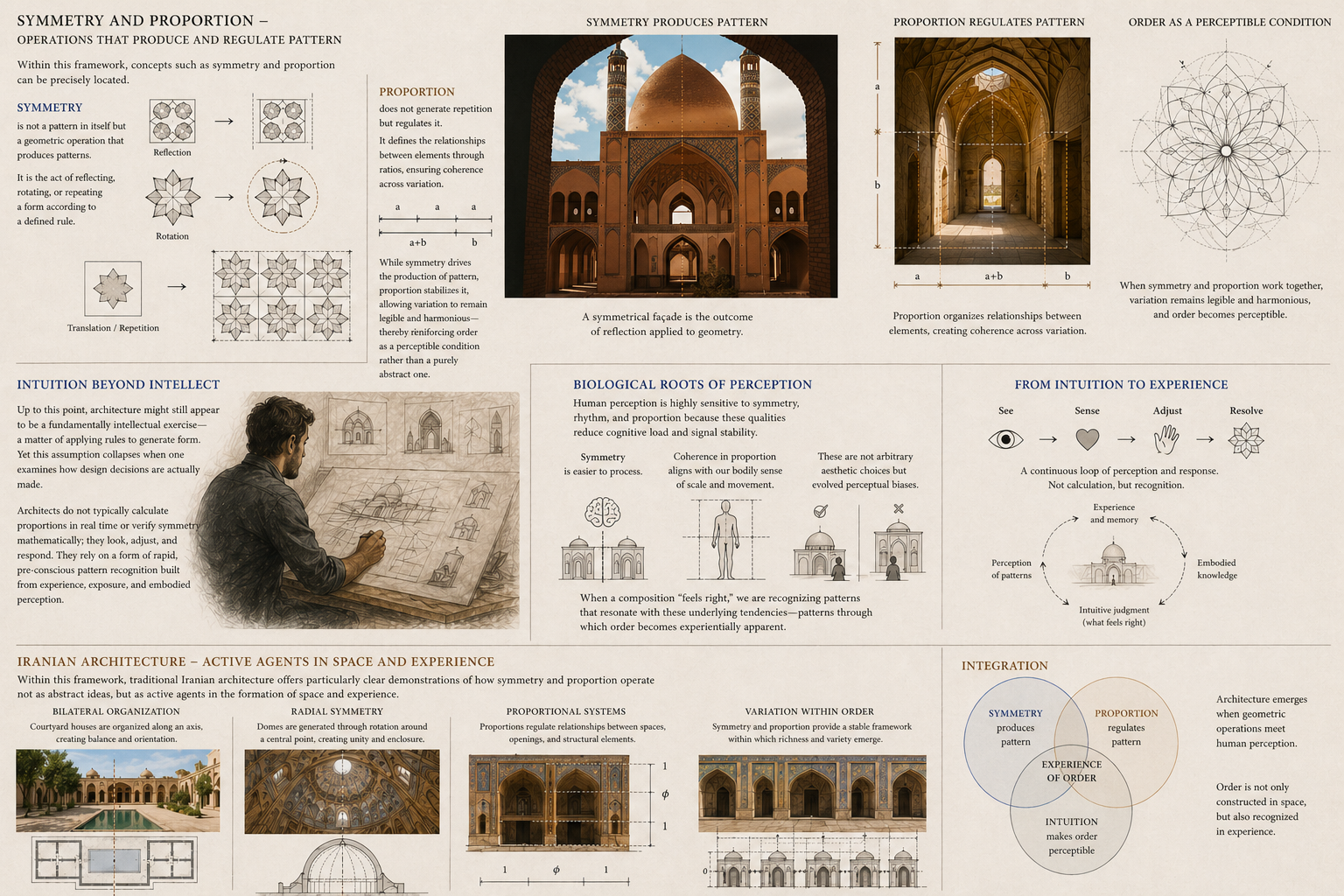
Within this framework, concepts such as symmetry and proportion can be precisely located. Symmetry is not a pattern in itself but a geometric operation that produces patterns. It is the act of reflecting, rotating, or repeating a form according to a defined rule. A symmetrical façade, a radial dome, or a bilaterally organized plan are not merely compositions; they are the outcomes of specific transformations applied to geometry. Proportion, by contrast, does not generate repetition but regulates it. It defines the relationships between elements through ratios, ensuring coherence across variation. While symmetry drives the production of pattern, proportion stabilizes it, allowing variation to remain legible and harmonious—thereby reinforcing order as a perceptible condition rather than a purely abstract one.
Up to this point, architecture might still appear to be a fundamentally intellectual exercise—a matter of applying rules to generate form. Yet this assumption collapses when one examines how design decisions are actually made. Architectural culture often presents itself as a domain of conscious reasoning: we analyze geometry, choose proportions, and deliberately compose patterns. In practice, however, a significant portion of design occurs through intuition. Architects do not typically calculate proportions in real time or verify symmetry mathematically; they look, adjust, and respond. They rely on a form of rapid, pre-conscious pattern recognition built from experience, exposure, and embodied perception.
This intuitive process has deep biological roots. Human perception is highly sensitive to symmetry, rhythm, and proportion because these qualities reduce cognitive load and signal stability. A symmetrical arrangement is easier to process than an irregular one; a coherent proportional system aligns with our bodily sense of scale and movement. These preferences are not arbitrary aesthetic choices but evolved perceptual biases. When an architect judges that a composition “feels right,” they are not solving equations but recognizing patterns that resonate with these underlying tendencies—patterns through which order becomes experientially apparent.
Within this framework, traditional Iranian architecture offers particularly clear demonstrations of how symmetry and proportion operate not as abstract ideas, but as active agents in the formation of space and experience.
The Shah Mosque in Isfahan (مسجد شاه), Symmetry]
-
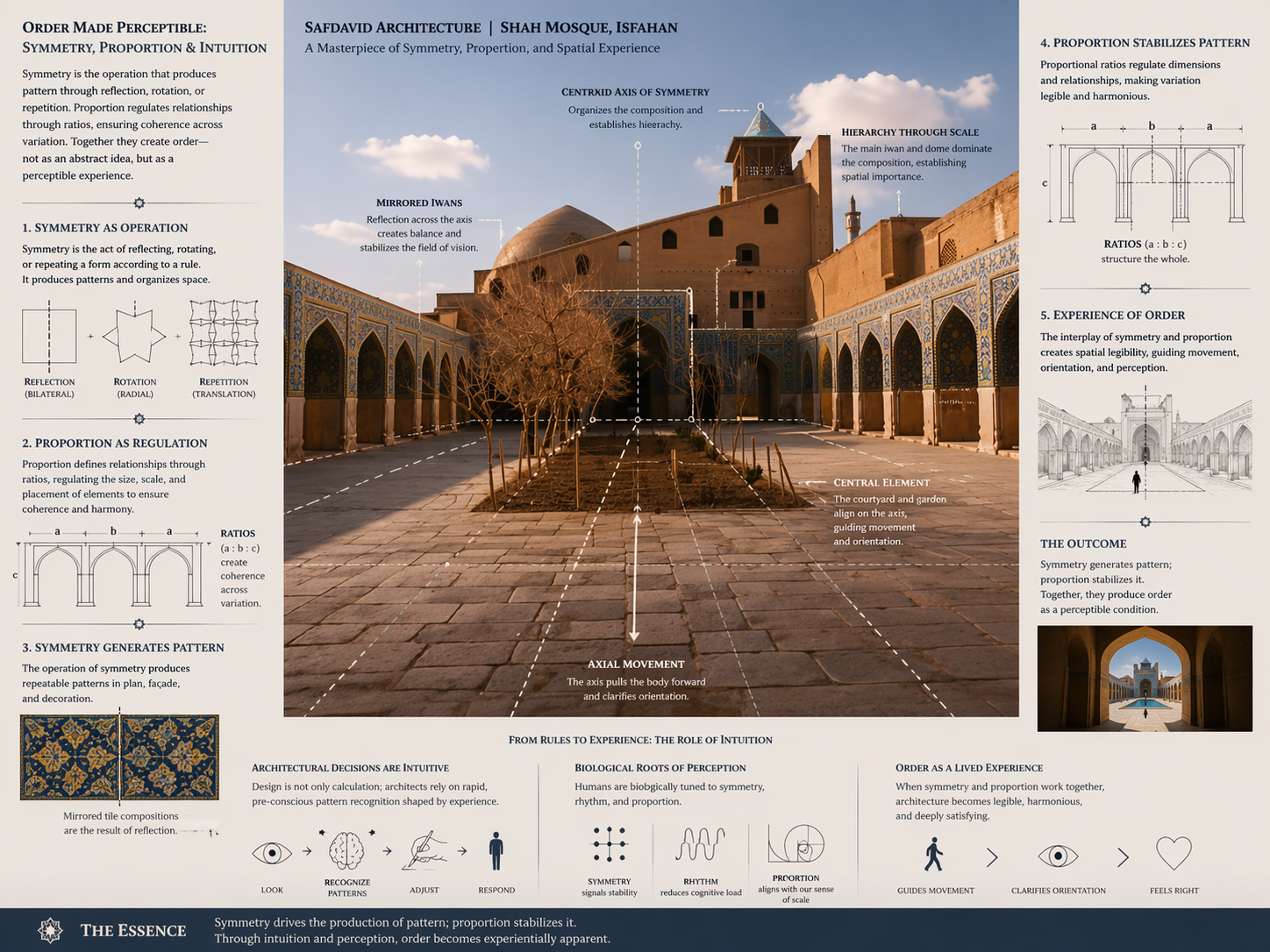
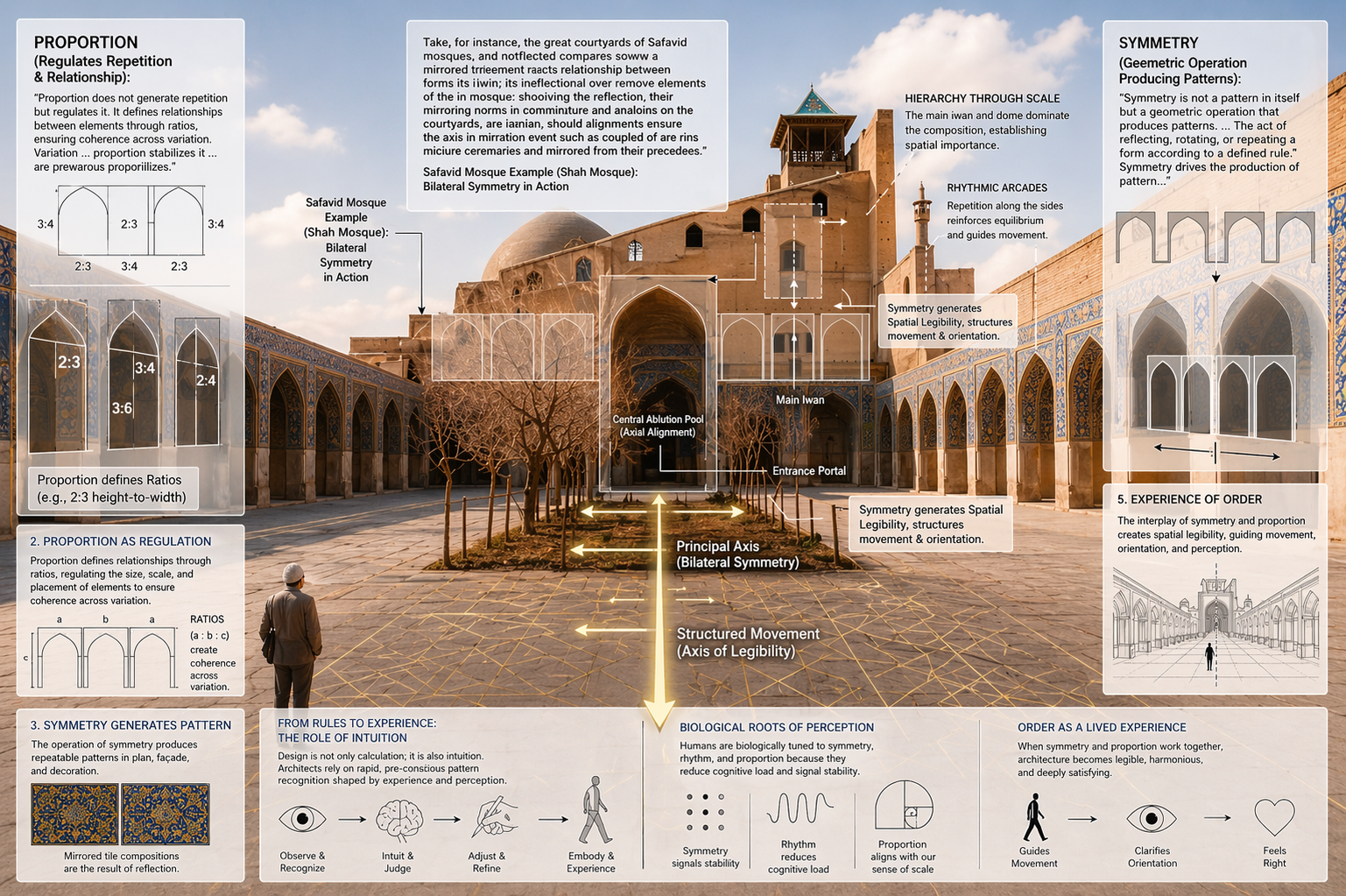
Take, for instance, the great courtyards of Safavid mosques, such as the Shah Mosque in Isfahan (مسجد شاه). The courtyard is organized through a rigorous bilateral symmetry along its principal axis, aligning the entrance portal, the central basin, and the main iwan leading to the prayer hall. This symmetry is not merely a visual preference; it is a geometric operation that structures movement, orientation, and hierarchy. As one enters, the space immediately clarifies itself—the axis pulls the body forward, the mirrored iwans stabilize the field of vision, and the repetition of arcades along the sides reinforces a sense of equilibrium. The patterns that we perceive—the sequence of arches, the mirrored tile compositions—are the direct consequences of this underlying operation of reflection. Symmetry here generates a pattern, but more importantly, it produces spatial legibility.
The Shah Mosque in Isfahan (مسجد شاه), Symmetry]
-
Yet symmetry alone would risk monotony without the regulating force of proportion. In the same courtyard, the relationships between height and width, between the scale of the iwans and the enclosing arcades, and between the central void and its surrounding masses are all carefully modulated. These proportional relationships ensure that repetition does not become overwhelming. The large central iwan, for example, dominates the composition not by breaking symmetry, but by operating within a different proportional register—its scale calibrated to establish hierarchy while remaining coherent with the whole. Proportion, in this sense, stabilizes the effects of symmetry, allowing variation to emerge without disrupting order.
[The Jameh Mosque of Saveh (مسجد جامع ساوه), Symmetry]
-
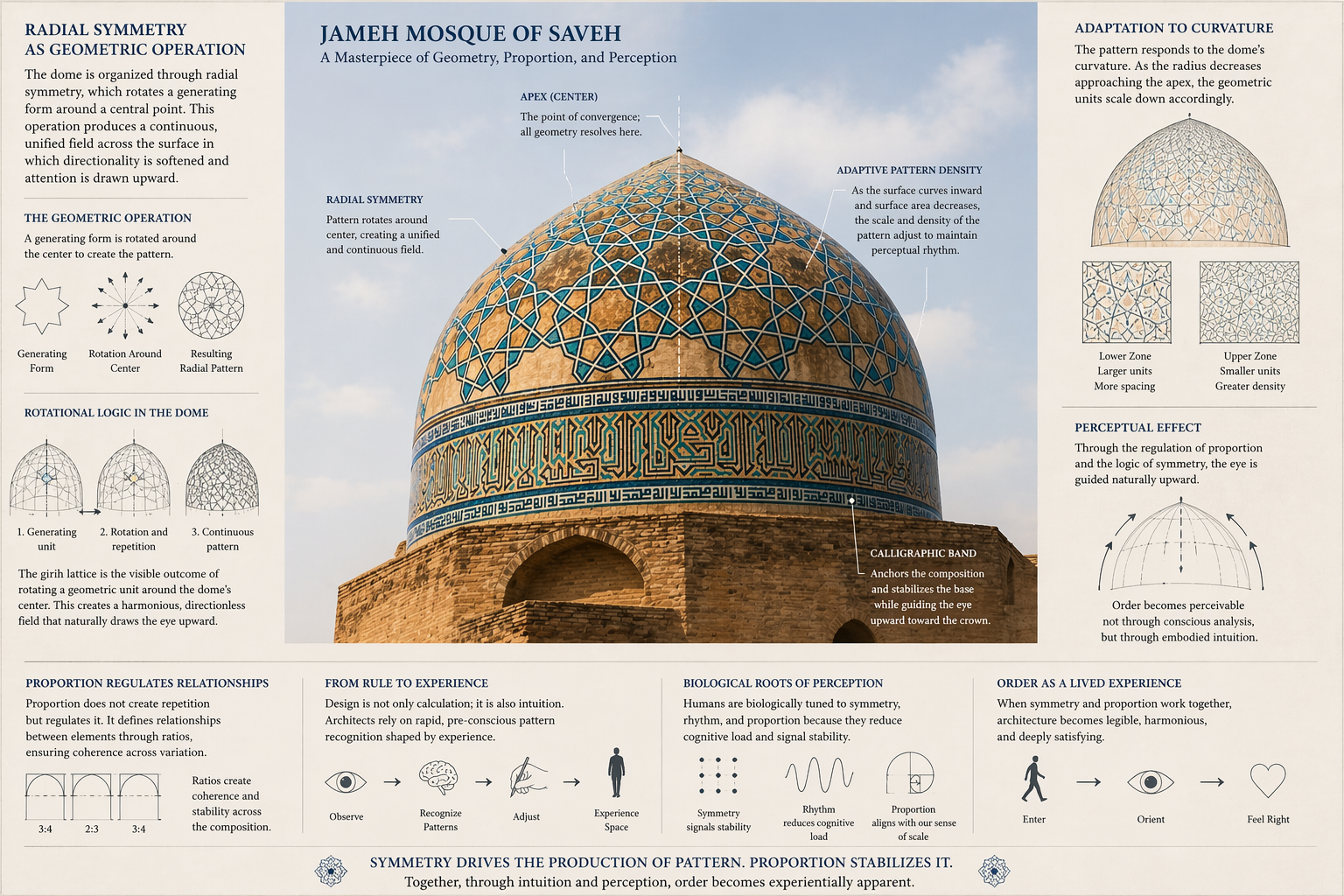
A striking monumental example can be found on the exterior dome of the Jameh Mosque of Saveh (مسجد جامع ساوه). Here, the spherical shell is organized through radial symmetry, a geometric operation that rotates a generating form around a center. This produces a continuous, unified field across the surface in which directionality is softened, and attention is drawn upward. The intricate girih lattice—articulated in turquoise and cobalt-glazed tiles against the warm, structural brick—is not an applied embellishment, but the visible outcome of this rotational logic. As the physical surface curves inward toward the apex, the scale and density of the geometric patterns adjust in response to the diminishing surface area, maintaining a consistent perceptual rhythm. Anchored by the monumental calligraphic band at its base, the eye is guided naturally toward the crown of the dome, not through conscious analysis, but through the quiet regulation of proportion embedded within the geometric net itself.
[The Borujerdi House in Kashan (خانه بروجردیها), Symmetry]
-
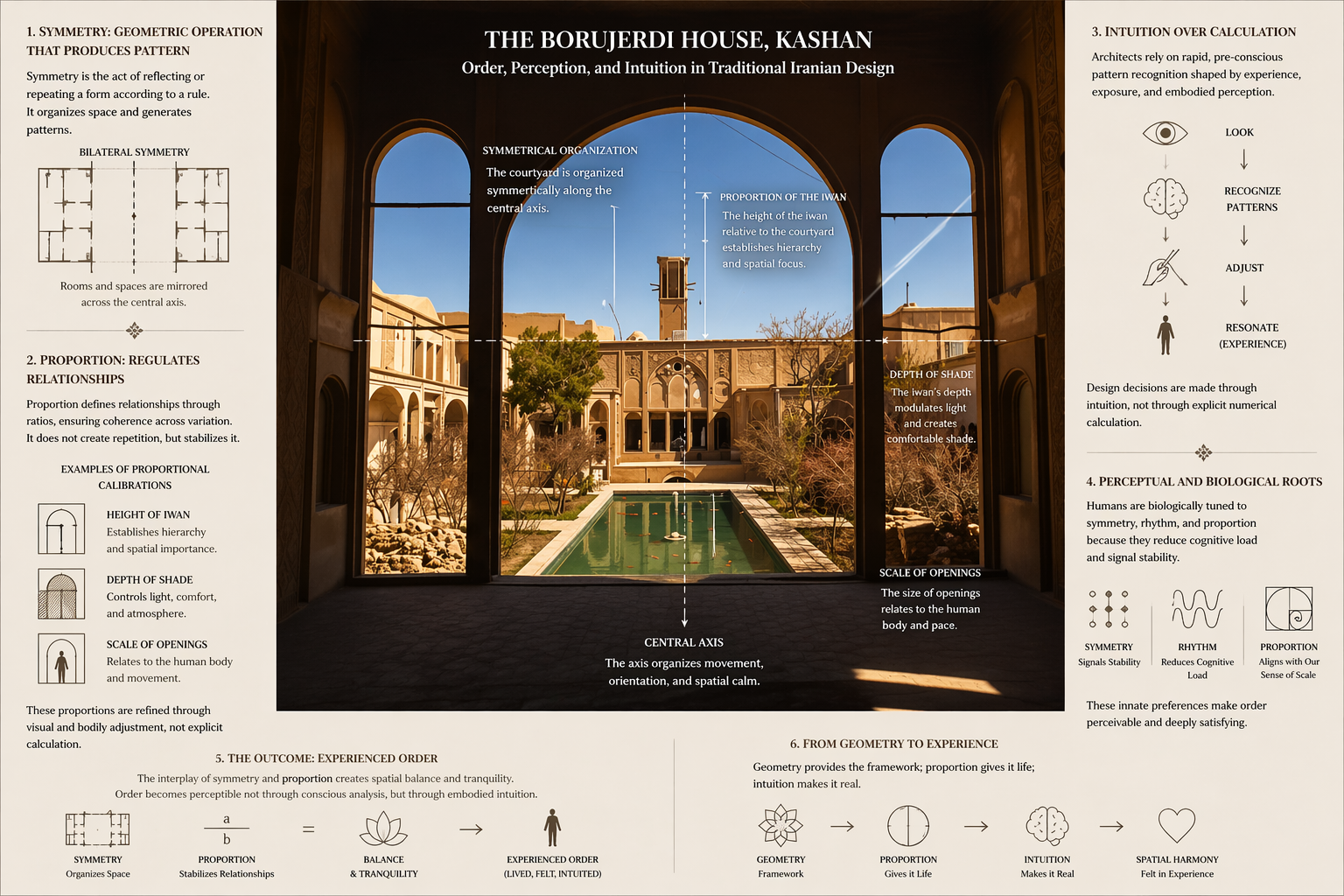
This interplay is equally evident in the traditional houses of cities like Yazd and Kashan. In houses such as the Borujerdi House (خانه بروجردیها), the central courtyard is often organized symmetrically, with rooms mirrored across an axis. However, the lived experience of the space is shaped by proportional nuances: the height of the iwan (ایوان) relative to the courtyard, the depth of the shade (سایه) it casts, and the scale of the openings relative to the human body (بدن). These proportional calibrations are rarely calculated explicitly and numerically during design; rather, they are refined through visual and bodily adjustment. The resulting spaces feel balanced and tranquil (آرام)—not because their ratios are intellectually known, but because they align with deeply ingrained perceptual expectations.
[The Shāh Ni ‘Matiullah Walī (شاه نعمتالله ولی), Symmetry]
-
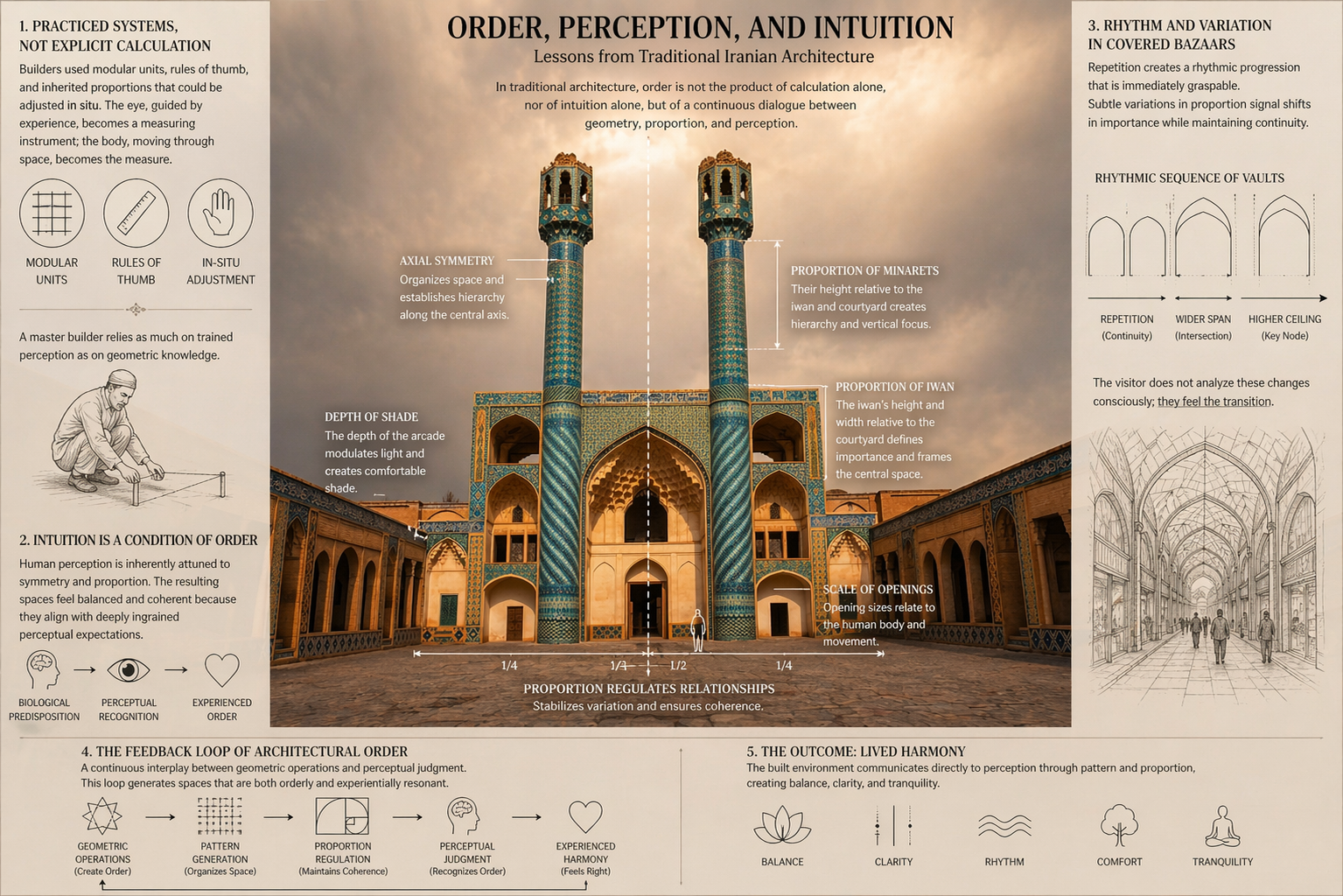
It is precisely here that the apparent divide between rational design and intuitive judgment begins to dissolve. The builders and architects of these environments did not rely on continuous measurement or explicit calculation in the modern sense. Instead, they worked through practiced systems—modular units, rules of thumb (قواعد), and inherited proportions—that could be adjusted in situ. A master builder laying out a courtyard or shaping a dome would rely as much on trained perception as on geometric knowledge. The eye, guided by experience, becomes a measuring instrument; the body, moving through space, becomes a measure (معیار) for proportion.
This reliance on intuition is not a departure from order, but one of its necessary conditions. Human perception is inherently attuned to symmetry and proportion. In the covered bazaars (بازارهای سرپوشیده) of Iran, for example, the repeated sequence of vaults creates a rhythmic progression that is immediately graspable. Each bay is similar, yet slight proportional variations—wider spans at intersections, higher ceilings at key nodes (نقاط مهم)—signal shifts in importance without disrupting continuity. A visitor does not consciously analyze these changes; they simply feel the transition. The space communicates directly to perception through pattern and proportion.
What emerges from these examples is a more nuanced understanding of architectural order. It is not the product of rigid calculation alone, nor is it the result of purely subjective intuition. Rather, it arises from a continuous feedback loop between geometric operations and perceptual judgment. Symmetry generates patterns that organize space; proportion regulates these patterns to maintain coherence; and human perception, shaped by biological predispositions, recognizes and affirms this coherence almost instantaneously.
In traditional Iranian architecture, this alignment is achieved with remarkable precision. The built environment speaks a language that is at once mathematical and sensorial. One does not need to understand the underlying rules (قواعد) to experience their effects. The order is felt before it is analyzed—apprehended through the body and the eye as a condition of clarity, balance, and tranquility (آرامش).
Broken Symmetry
The Berkeley Art Museum and Pacific Film Archive (BAMPFA) asymmetry]
-
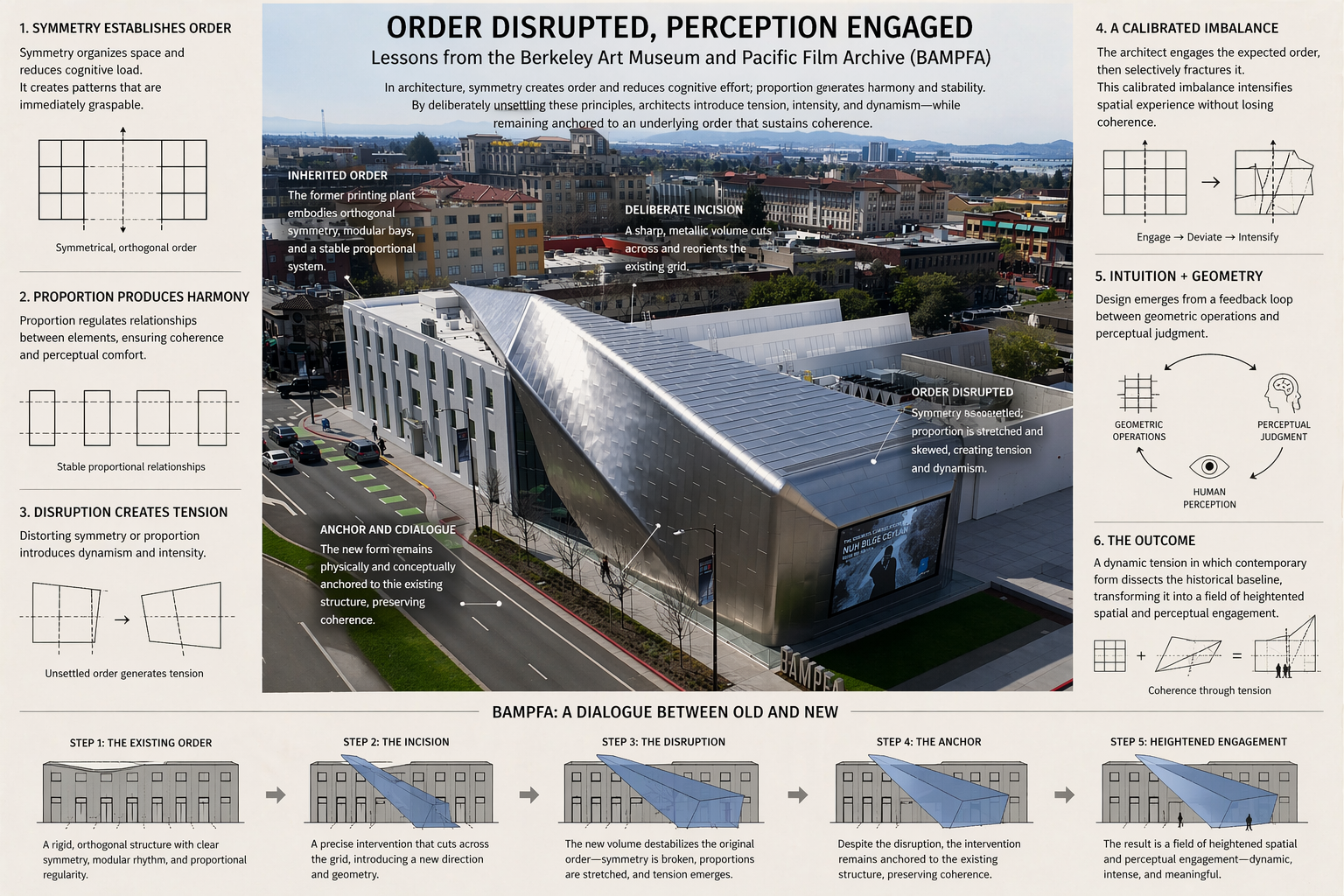
This dynamic becomes especially legible in modern and contemporary architecture, where symmetry and proportion are deliberately unsettled. If symmetry establishes order and reduces cognitive effort, its disruption introduces tension; if proportion produces harmony, its distortion generates intensity and dynamism. These strategies operate by engaging, then deviating from, deeply ingrained perceptual expectations. The architect constructs a formal system only to selectively fracture it, producing a calibrated imbalance that intensifies spatial experience without dissolving coherence.
The Berkeley Art Museum and Pacific Film Archive (BAMPFA) exemplify this condition. Diller Scofidio + Renfro’s intervention inserts a sharp, metallic volume into the heavy, orthogonal concrete frame of the former printing plant, creating a deliberate collision between new and old. The reflective, faceted addition cuts across and reorients the inherited structural grid, destabilizing its rigid logic while remaining anchored to it. This is not a wholesale rejection of the existing order, but a precise incision—an operation that both reveals and disrupts the latent geometry of the original building. The result is a dynamic tension in which contemporary form actively dissects the historical baseline, transforming it into a field of heightened spatial and perceptual engagement.
At this stage, the discussion remains incomplete if confined solely to internal design processes, because architecture does not exist in abstraction but is shaped by a broader environment—one that is simultaneously climatic, social, cultural, and religious. Climate, sunlight, wind, and topography impose material and performative constraints, transforming geometry into responsive systems. A façade becomes an instrument that modulates heat and light, and a plan evolves into a field of airflow and thermal exchange. Yet these environmental forces extend beyond the physical: social practices, cultural norms, and religious orientations equally structure space, embedding architecture within systems of meaning as much as performance. Nature and culture together establish the operative rules through which geometry becomes adaptive, and order becomes ecological and symbolic rather than purely formal.
[The Shah Mosque (مسجد شاه) + Naghsh-e Jahan Square (میدان نقش جهان)]
-
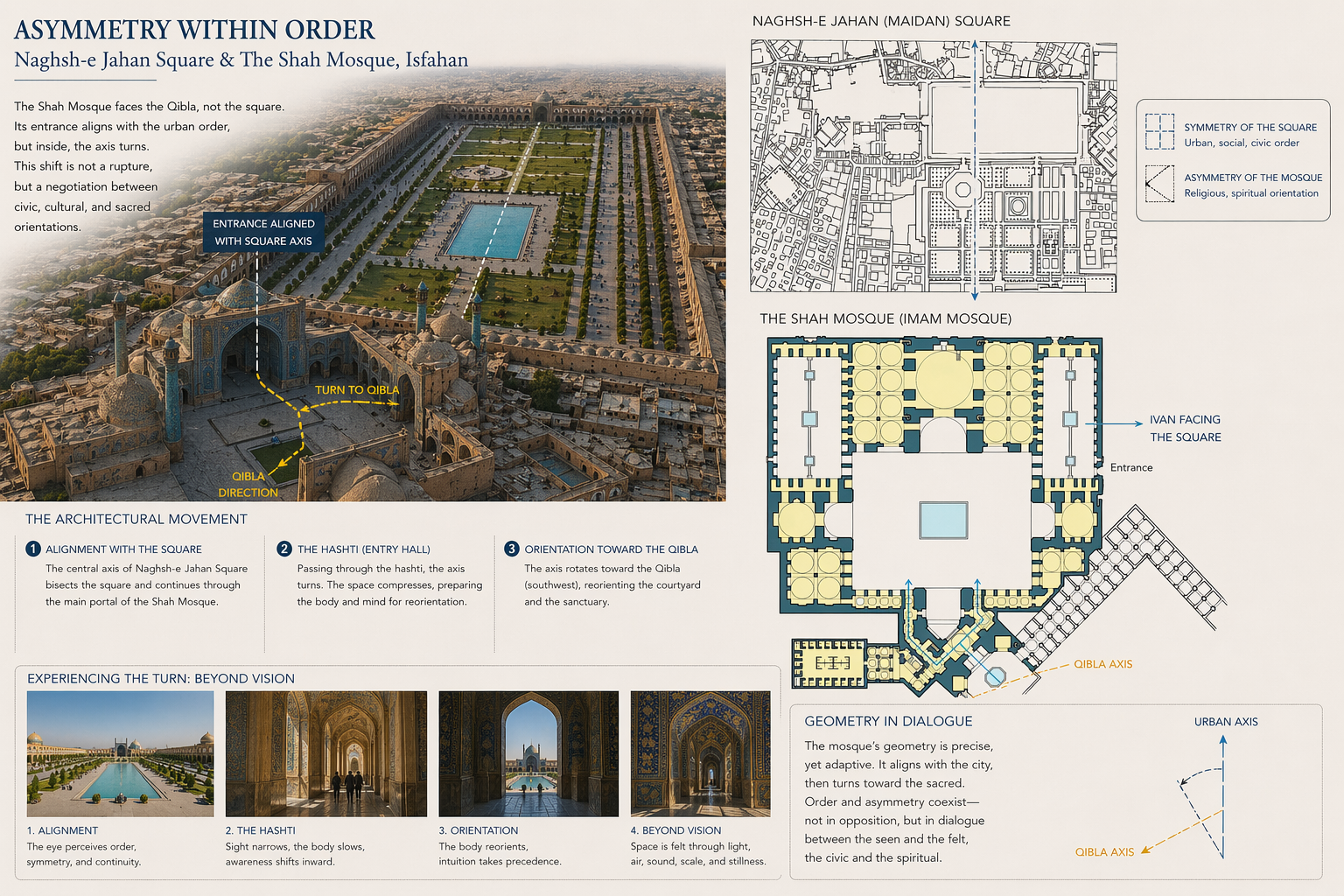
This expanded field complicates the architect’s role, requiring a synthesis of intellect and intuition. Geometry provides precision and order, while intuition guides its transformation in response to layered environmental forces. The Shah Mosque (مسجد شاه) in Isfahan (اصفهان) exemplifies this condition. Its entrance aligns with the ordered Naghsh-e Jahan Square (میدان نقش جهان), reinforcing urban and social coherence, yet upon passing through the hashti (هشتی), the spatial axis rotates toward the Qibla (قبله), reflecting a religious imperative. This shift is not a rupture but a negotiation between civic, cultural, and sacred systems.