12. Rewriting Space: Social Change and the Endurance of Geometric Order
[The Tarikhaneh Mosque (تاریخانه) in Damghan, Rewriting Space]
-
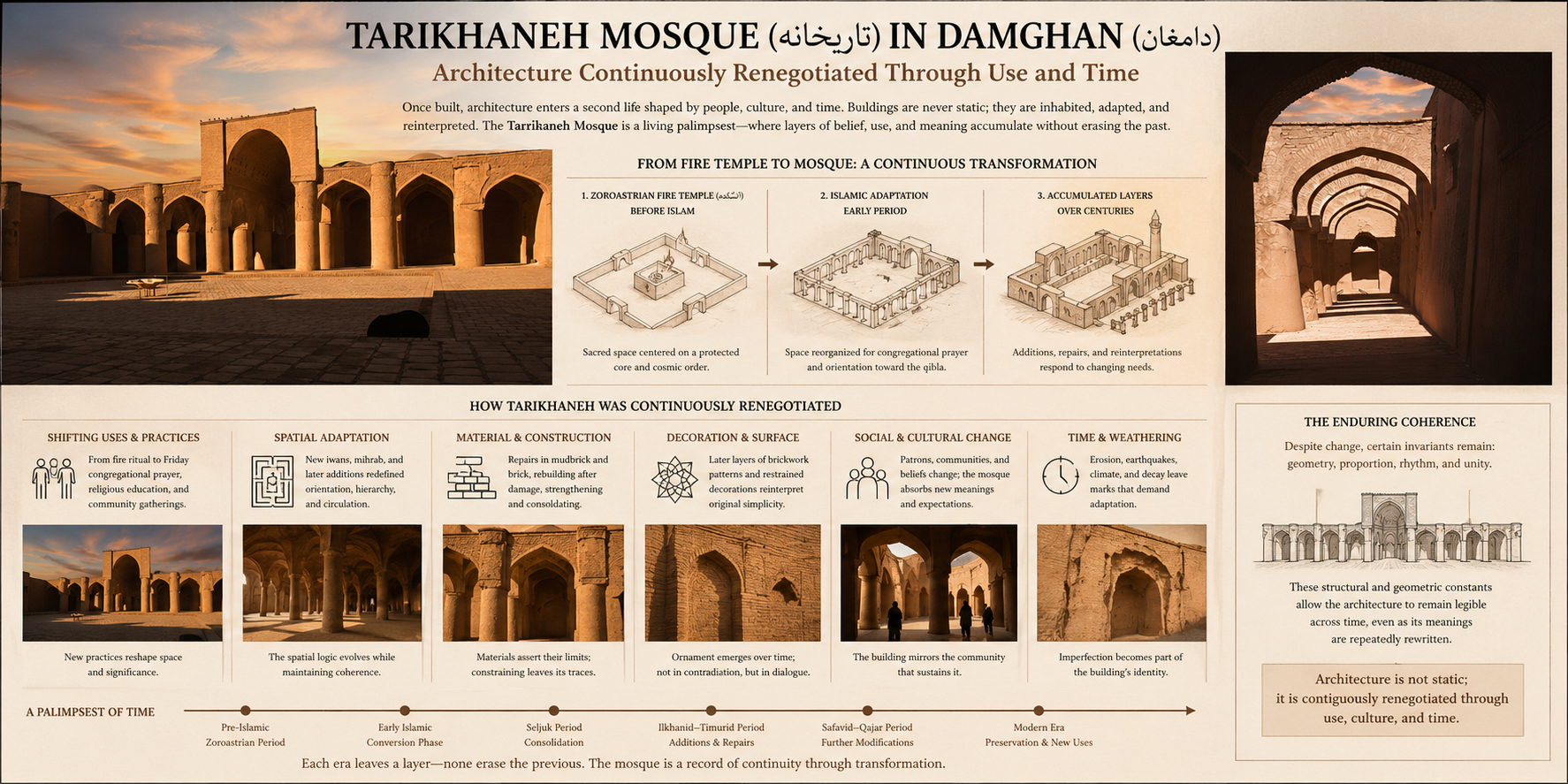
Once constructed and grounded in material reality, buildings enter a second phase of transformation driven by social behavior. Architecture exists in a persistent tension between intention and occupation. Buildings are conceived as ordered systems—formal and symbolic constructs shaped by ideology and design discipline—but once inhabited, they enter a far less controlled domain. Social behavior, cultural practice, and time begin to reshape them. Users adapt spaces in ways that may diverge from their intended program—circulation paths shift, thresholds blur, and new uses emerge. Over time, these incremental changes accumulate, altering the building’s spatial logic and even its identity. What was conceived as a fixed composition becomes an evolving framework. The order established by the architect is not erased, but continuously renegotiated through occupation, cultural practices, and shifting social needs. Architecture is not simply used; it is rewritten. What begins as a coherent architectural statement gradually becomes layered and hybridized, accumulating traces of adaptation and reinterpretation. In this sense, a building shifts from being a fixed object to an evolving process.
The Tarikhaneh Mosque (تاریخانه) in Damghan (دامغان) exemplifies this condition particularly clearly. Believed to have originated as, or been built upon, a Zoroastrian fire temple (آتشکده), it embodies a transition between two distinct religious and cosmological systems. Zoroastrian sacred space centered on a contained, protected core, while Islamic architecture reorganized space around collective prayer, orientation toward the qibla (قبله), and rhythmic repetition. Yet this transformation did not result in complete erasure. Instead, it involved a reinterpretation of existing spatial logic. The repetitive columns and structural rhythms of the mosque echo earlier systems, revealing the building as a palimpsest—where traces of one worldview persist within another.
-
This phenomenon extends beyond Tarikhaneh (تاریخانه) to many Jameh Mosques (مساجد جامع) across Iran (ایران), including the Jameh Mosque of Qazvin (مسجد جامع قزوین). These structures have undergone continuous modification across successive dynasties—Seljuk, Ilkhanid, Safavid, and Qajar—often to the point where their original configurations are difficult to identify. However, this apparent loss of origin is misleading. What persists is not the visible form, but the underlying system of order: geometry, proportion, symmetry, and hierarchy. Even as names, functions, and decorative expressions change, these foundational principles remain intact, providing continuity beneath layers of intervention.
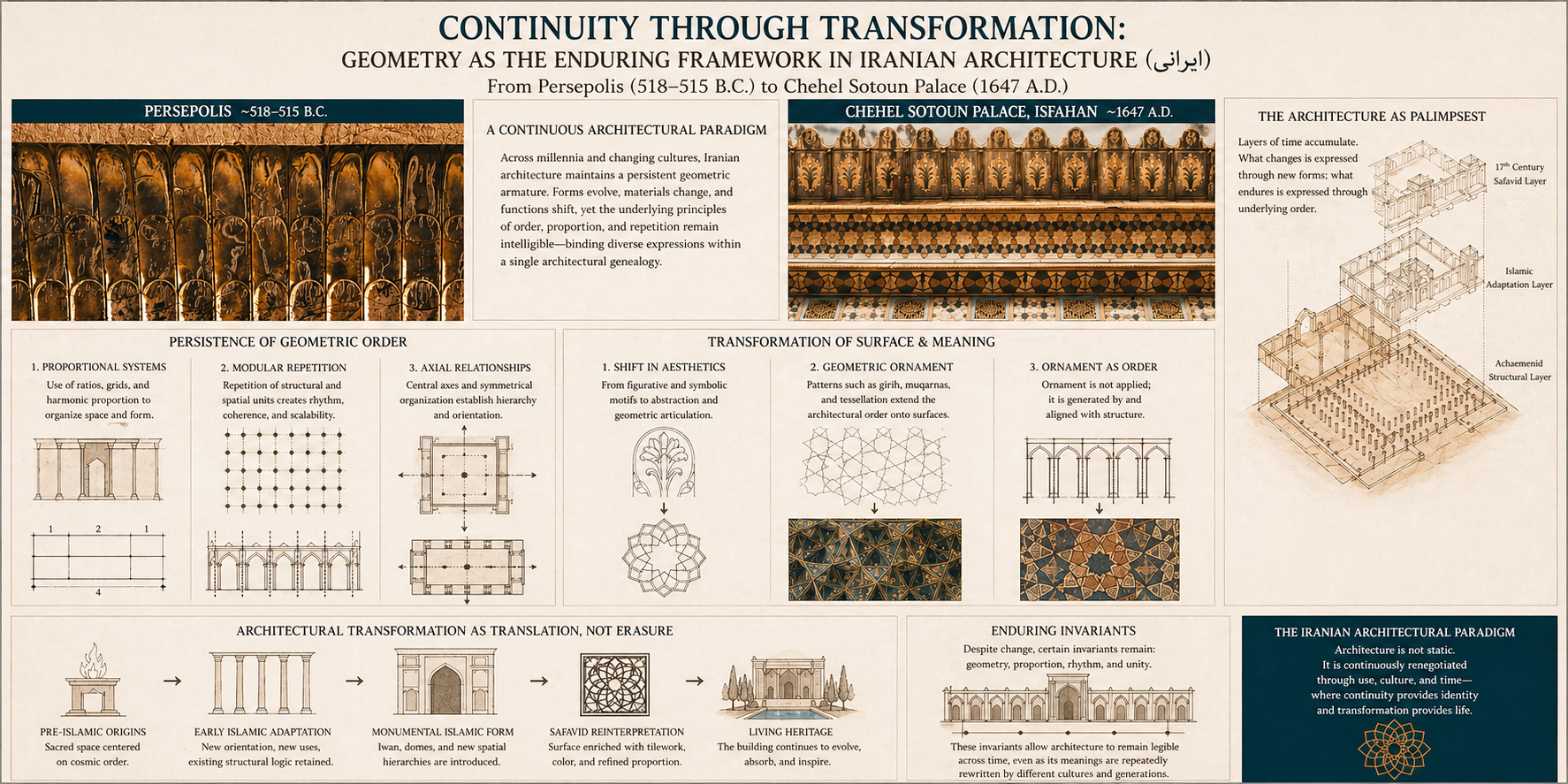
This persistence reflects a deeper architectural paradigm in Iranian (ایرانی) tradition, where geometry operates as both a generative and conceptual framework. Across pre-Islamic and Islamic periods, space is organized through proportional systems, modular repetition, and axial relationships. Even when buildings are expanded, reconstructed, or reprogrammed, this geometric armature endures. Columns may be replaced, iwans (ایوان) inserted, domes rebuilt, and surfaces retiled, yet the underlying order remains legible. What appears as rupture at the surface level often conceals continuity at the structural level.
The evolution of ornament reinforces this continuity through transformation. With the transition to Islamic aesthetics, figurative and symbolic motifs gave way to abstraction, particularly geometric patterning. This shift does not represent a loss of meaning, but rather a transformation in its expression. Geometry, already central to spatial organization, becomes the primary medium of visual articulation through patterns such as girih (گره), muqarnas (مقرنس), and tessellation. Ornament is no longer merely applied decoration; it is an extension of the building’s underlying order, aligning surface with structure.
In this light, architectural transformation can be understood less as erasure and more as translation. New cultural and political frameworks reinterpret inherited forms through different symbolic languages while retaining their structural grammar. The difficulty in identifying an “original” design is not evidence of its disappearance, but of its absorption into a more complex whole. These buildings operate across multiple temporal layers simultaneously, where visible change coexists with deeper continuity.
Ultimately, structures like Tarikhaneh (تاریخانه) and the Jameh mosques (مساجد جامع) demonstrate that architecture is not static but continuously renegotiated through use and time. Their endurance lies in their capacity to absorb transformation while maintaining internal coherence. Geometry, proportion, and unity act as invariants—allowing architecture to remain legible even as its meanings are repeatedly rewritten.