7. Order
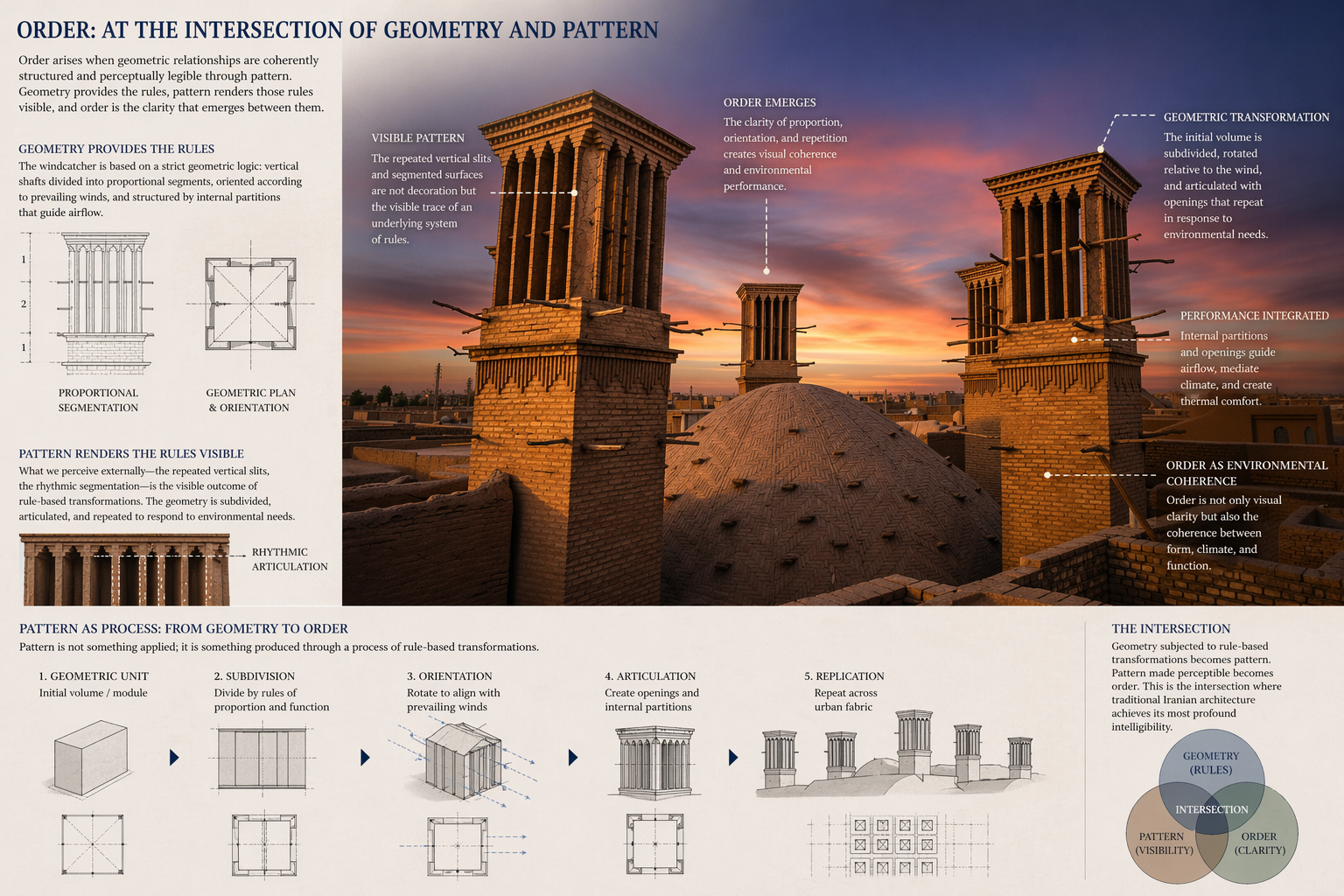
The windcatchers of Yazd (بادگیر), Order]
-
It is at this intersection that the notion of order becomes fully intelligible. Order is not identical with geometry, nor reducible to pattern; it is the condition that arises when geometric relationships are coherently structured and perceptually legible through pattern. Geometry provides the rules, pattern renders those rules visible, and order is the clarity that emerges between them.
To understand this relationship more precisely, one must move beyond the notion of pattern as a static object. Traditionally, architectural patterns have been treated as decorative elements—brick bonds, tile arrangements, façade motifs. But this view reduces pattern to appearance and ignores its generative nature. A more accurate formulation is to understand pattern as the result of a process: geometry subjected to rule-based transformations across space and time. A pattern is not something applied; it is something produced.
This shift from object to process is critical. It begins with a geometric unit—a panel, a module, a structural bay—and applies a set of operations to it. These operations may be simple, such as translation or repetition along a grid, or more complex, such as rotation, scaling, or distortion in response to environmental forces. Once these transformations are applied and distributed across a field—whether a façade, a plan, or a temporal sequence—a pattern emerges. What appears to the observer as an expressive surface is, in fact, the visible trace of an underlying system of rules.
It is precisely at this intersection—where geometry is transformed and made perceptible—that traditional Iranian architecture offers some of its most compelling lessons. Here, order is never an abstract ideal; it is something constructed, revealed, and continuously reinforced through the interplay of underlying systems and their visible manifestations.
A clear example can be found in the بادگیر (windcatchers) of Yazd. At first glance, these vertical structures appear as expressive silhouettes punctuating the skyline. Yet their form is governed by a strict geometric logic: vertical shafts divided into proportional segments, oriented according to prevailing wind directions, and structured by internal partitions that guide airflow. What we perceive externally—the repeated vertical slits, the rhythmic segmentation of surfaces—is not decoration but the visible outcome of a series of rule-based transformations. The initial geometric volume is subdivided, rotated relative to the wind, and articulated with openings that repeat in response to environmental needs. The resulting pattern is therefore inseparable from performance; it is the trace of a process that mediates between climate and form. Order, in this case, emerges not only as visual clarity but as environmental coherence.
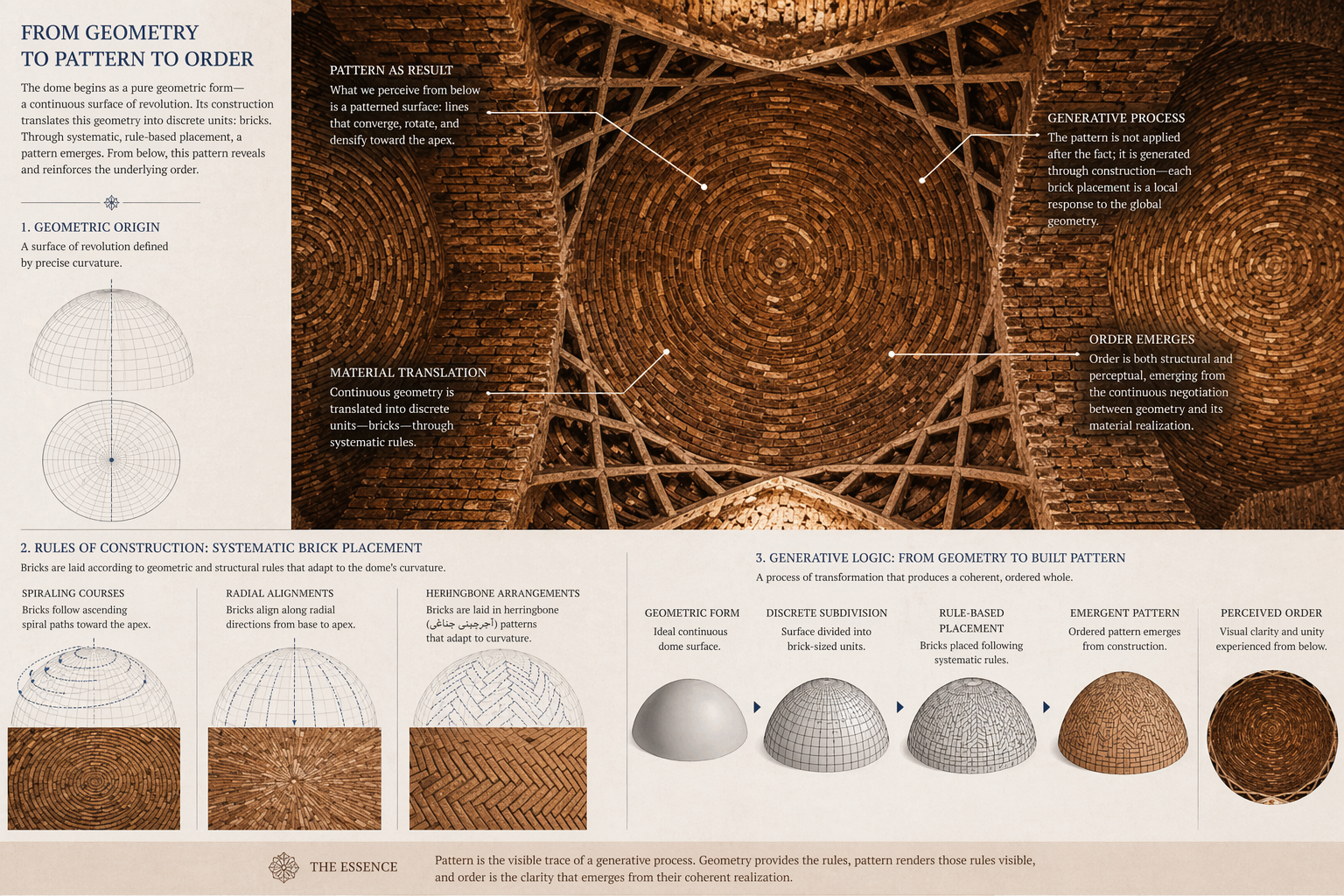
The Jameh Mosque of Yazd (مسجد جامع یزد), Order]
-
This generative understanding of pattern becomes even more explicit in the brickwork of traditional Iranian domes, such as those in the Jameh Mosque of Yazd (مسجد جامع یزد) and the smaller neighborhood mosques of central Iran, including the Jameh Mosque of Nain (مسجد جامع نایین). The dome begins as a pure geometric form—a surface of revolution defined by precise curvature. Yet its construction requires translating this continuous geometry into discrete units: bricks. The laying of these bricks follows systematic rules—spiraling courses, radial alignments, or herringbone arrangements (آجرچینی جناغی)—that adapt to the changing geometry of the dome as it rises. What one ultimately sees from below is a patterned surface: lines that converge, rotate, and densify toward the apex. This pattern is not applied after the fact; it is generated through the act of construction itself. Each brick placement is a local response to a global geometric condition, and the accumulation of these responses produces a coherent visual field. The order of the dome is thus both structural and perceptual, emerging from the continuous negotiation between geometry and its material realization.
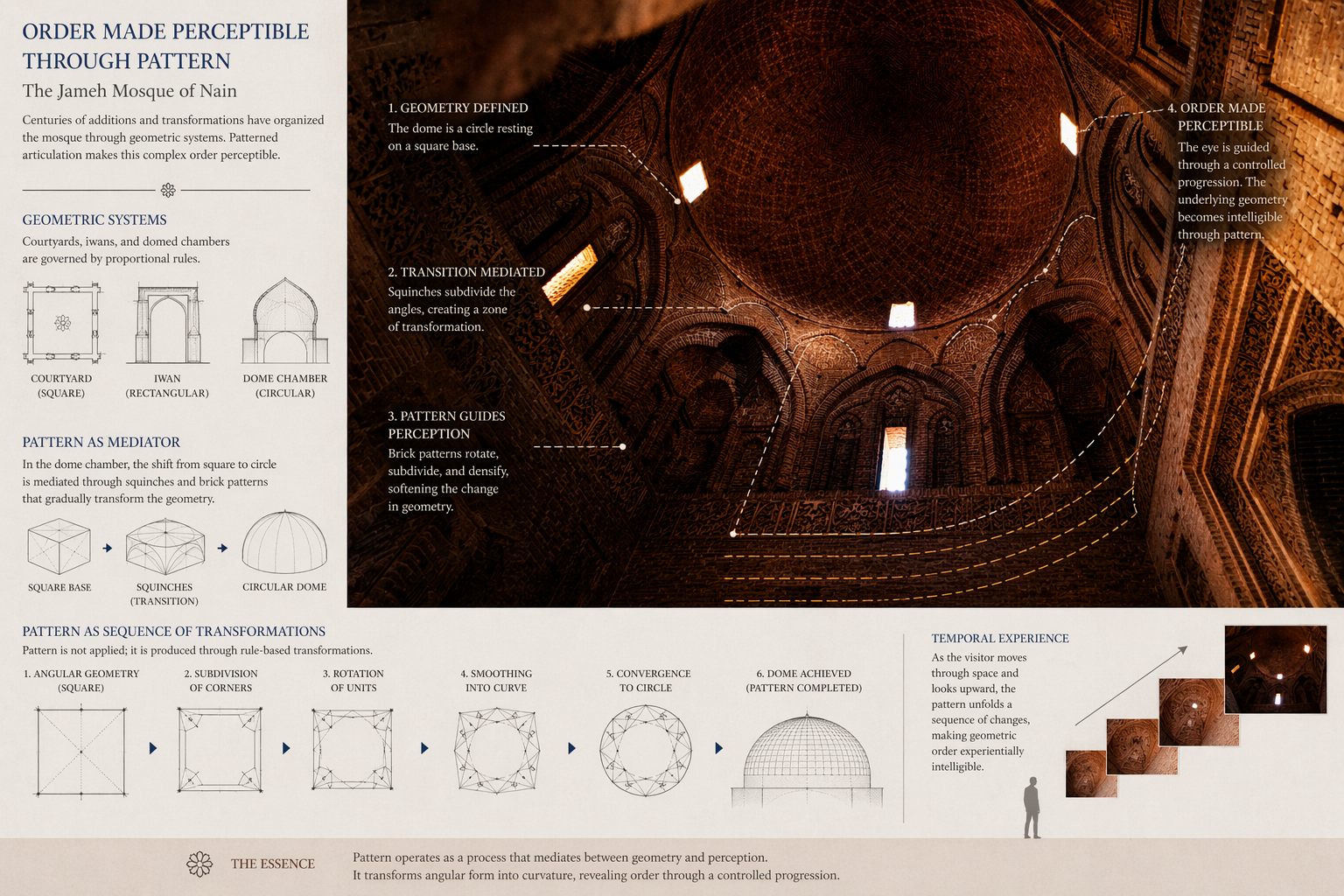
The Jameh Mosque of Nain (مسجد جامع نایین), Order]
-
The Jameh Mosque of Nain (مسجد جامع نایین) offers another, more layered illustration. Over centuries of additions and transformations, its spaces have been organized through a series of geometric systems—courtyards, iwans, domed chambers—each governed by proportional rules. Yet what allows a visitor to perceive this complex order is the patterned articulation of surfaces and transitions. In the dome chamber, for example, the shift from a square base to a circular dome is mediated through squinches and decorative brick patterns that gradually transform the geometry. These patterns operate as a sequence of transformations: angular forms are subdivided, rotated, and smoothed into curvature. The eye does not abruptly encounter a geometric change; it is guided through it. Pattern here becomes a temporal experience, unfolding as a visitor moves through space and looks upward, making the underlying geometry intelligible through a controlled progression.
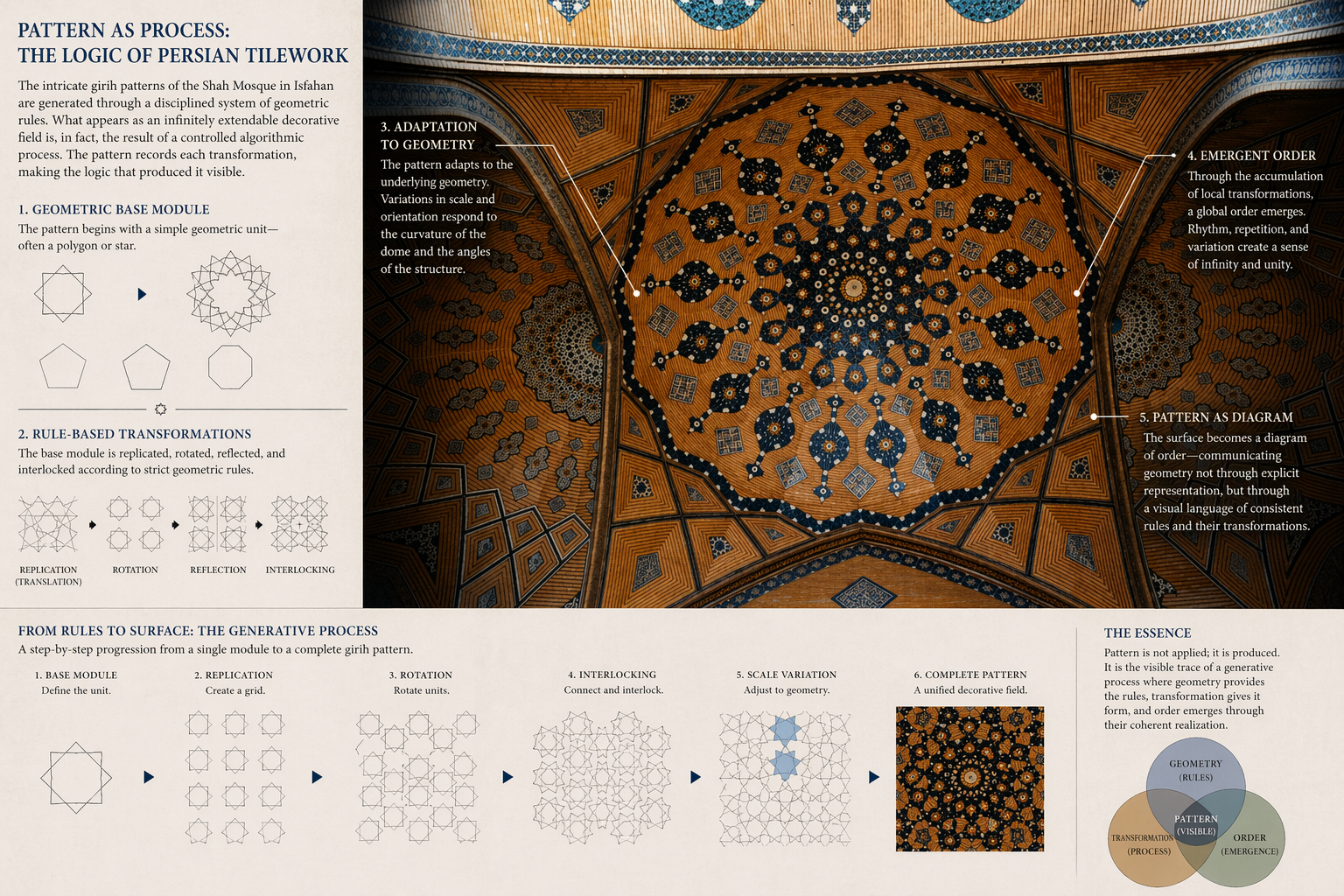
[The Shah Mosque in Isfahan (مسجد شاه), Order]
-
This sense of pattern as process is perhaps most refined in Persian tilework and brickwork, particularly in the Shah Mosque (مسجد شاه) in Isfahan. The intricate girih patterns that cover its surfaces are often perceived as purely ornamental, yet they are generated through a disciplined system of geometric rules. A base module—often a polygon or star—is replicated, rotated, and interlocked across a surface according to strict constraints. Variations in scale or orientation respond to shifts in the underlying geometry, such as the curvature of a dome or the angle of an iwan. What appears as an infinitely extendable decorative field is, in fact, the result of a controlled algorithmic process. The pattern records each transformation, making the logic that produced it visible. In this way, the surface becomes a kind of diagram—one that communicates order not through explicit representation, but through rhythm, repetition, and variation.
[The Bazaar, Isfahan (بازار اصفهان), Order]
-
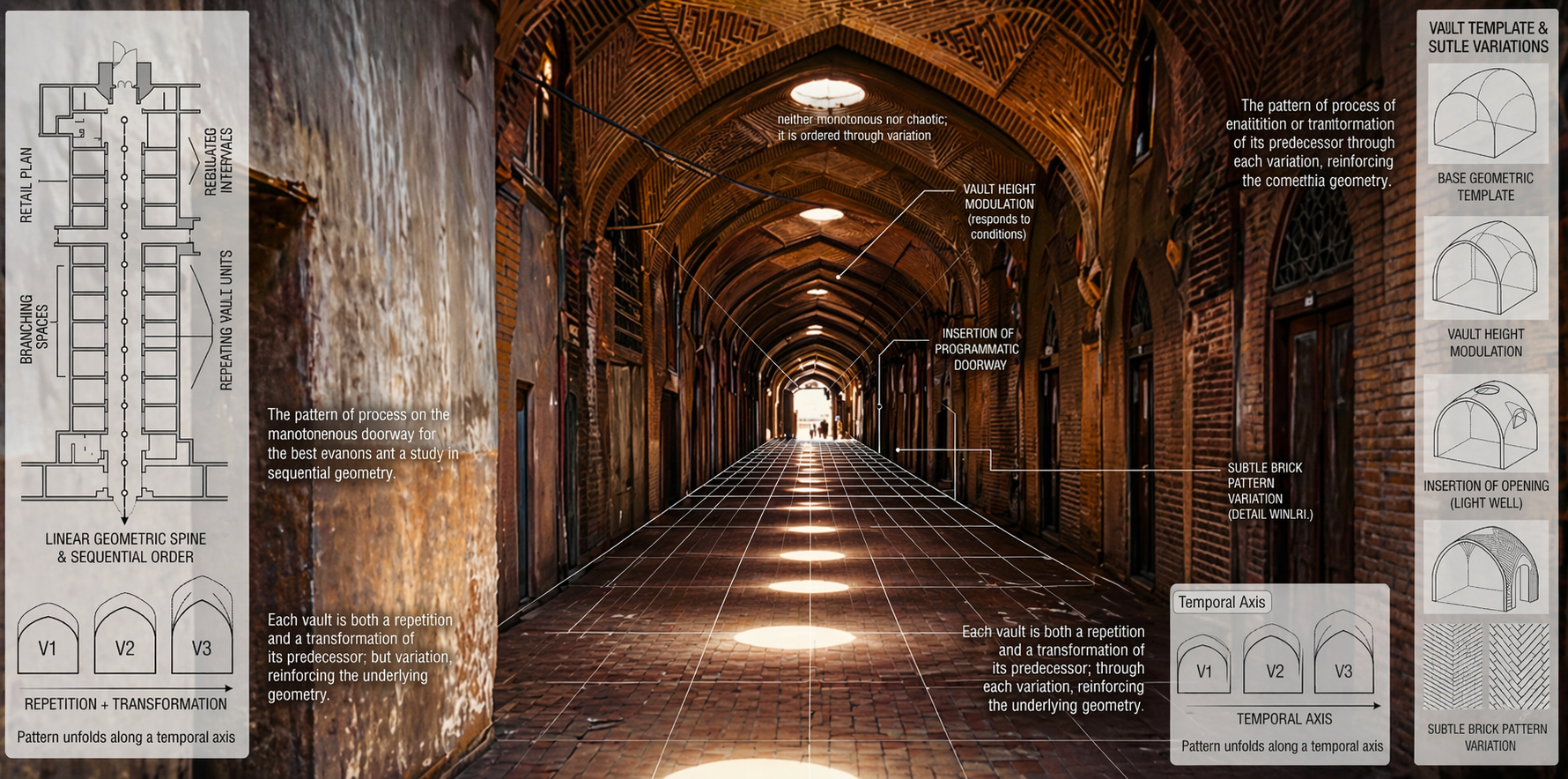
Even in more modest structures, such as the bazaars of cities like Tabriz or Kashan, this principle persists. The Bazaar of Isfahan (بازار اصفهان) is organized by a linear geometric spine, from which smaller spaces branch off in regulated intervals. Along this spine, a sequence of vaults repeats, each constructed from a similar geometric template. Yet subtle variations—changes in height, the insertion of openings, the modulation of brick patterns—respond to programmatic and environmental conditions. The resulting spatial experience is neither monotonous nor chaotic; it is ordered through variation. The pattern here unfolds along a temporal axis, revealed gradually as the viewer moves through the market. Each vault is both a repetition and a transformation of the previous one, reinforcing the underlying geometry while introducing perceptual richness.
What these examples collectively demonstrate is that pattern, in traditional Iranian architecture, cannot be understood as a static layer applied to form. It is inherently procedural—a sequence of operations acting upon a geometric base. Translation, rotation, scaling, and adaptation are not abstract concepts but concrete actions embedded in construction techniques, environmental responses, and material constraints. The visible patterns that emerge are therefore not ends in themselves; they are evidence of a deeper system at work.
Order, then, resides in this alignment between system and perception. It is achieved when the transformations applied to geometry are coherent enough to produce a unified whole, and when the resulting patterns are clear enough to communicate that coherence to the observer. In the best examples of Iranian architecture, this balance is handled with remarkable precision. Geometry provides the discipline, pattern conveys the process, and order emerges as a condition that is both intellectually structured and sensorially immediate—something that can be understood, but also directly felt.
[Traditional Hillside Settlements in Iran, Order]
-
To further extend the discussion of order within Architecture as Resonance: Geometry, Pattern, and the Architectural Process, it becomes necessary to move beyond the dichotomy of imposed versus emergent systems and to more fully articulate the lived mechanics through which order sustains itself. Order, when understood as resonance, is not merely the result of alignment or proportional harmony, but the continuous calibration of relationships—between elements, between moments, and between forces that are often only partially visible.
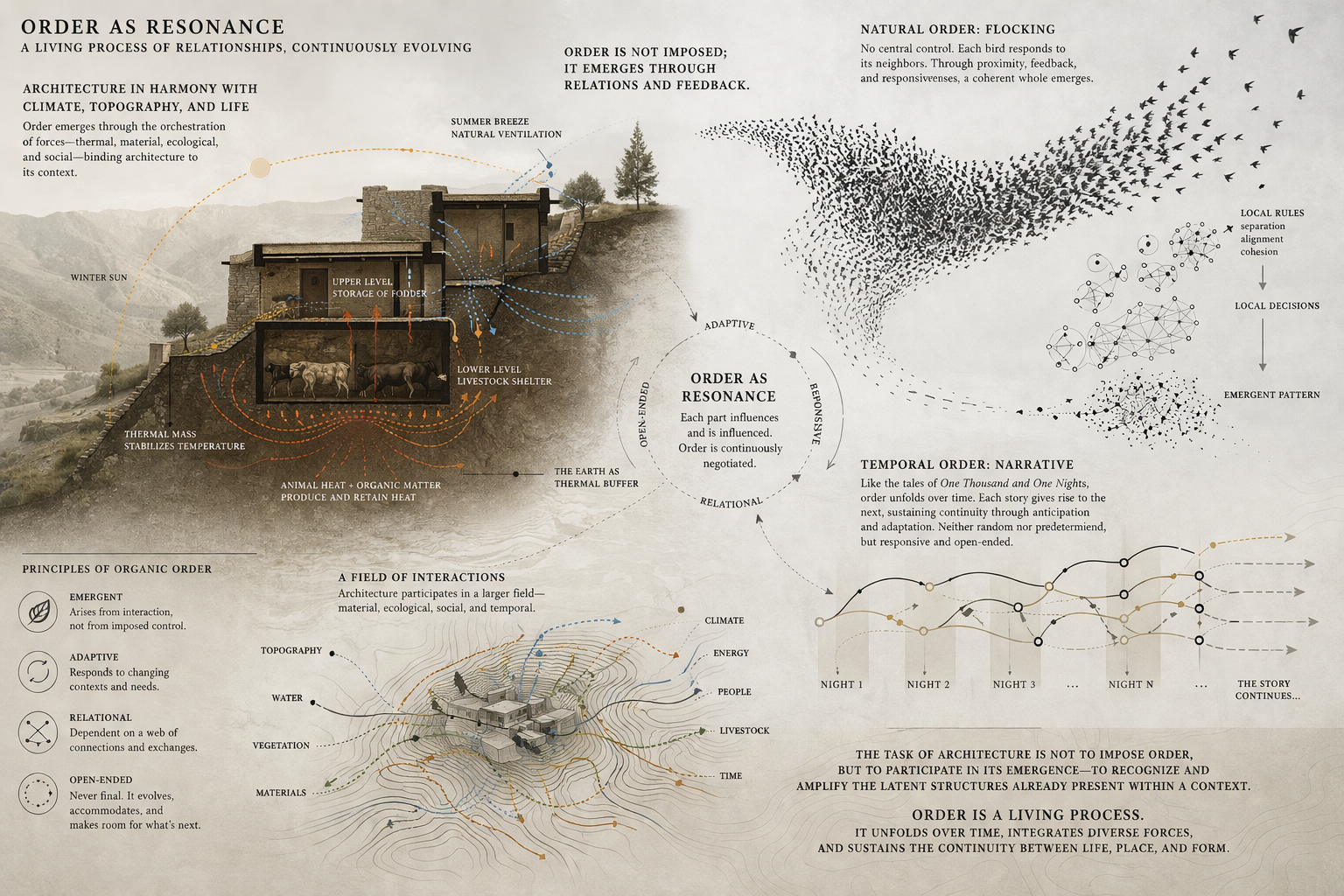
Examples of traditional hillside settlements in Iran begin to reveal this more nuanced condition, in which order is not simply spatial but thermodynamic, structural, and ecological. In regions shaped by pastoral life, architecture extends its logic beyond habitation into the cycles of sustenance. Homes constructed with one or even two basement levels—conditioned by slope and terrain—demonstrate a layered integration of life systems. The lower level, often housing livestock, and the upper level, used for storing fodder, are not arbitrary additions but precise responses to climate, gravity, and seasonal necessity. Traditional Hillside Settlements in Iran
These arrangements do more than accommodate function; they generate a deeper coherence. The mass anchors the structure into the hillside, lowering its center of gravity and enhancing stability. At the same time, the animal's metabolic heat production and the slow chemical transformation of organic matter contribute to the thermal regulation of the dwelling above in winter. What might appear as a vernacular convenience reveals itself instead as a sophisticated environmental modulation, where architecture participates in energy exchange rather than resisting it. In this sense, order emerges not only from spatial negotiation but from the orchestration of forces—thermal, material, and biological—that bind the building to its context.
Such examples underscore a critical distinction: organic order is not simply about incremental growth, but about relational intelligence. Each act of building is embedded in a matrix of dependencies, where structure, climate, and use are inseparable. The resulting environment does not strive for visual uniformity; rather, it achieves coherence through performance and reciprocity.
This condition finds a striking parallel in natural phenomena, where order manifests without centralized control. The coordinated movement of a flock of birds offers a compelling analogy. When threatened, each bird responds to its immediate neighbors, adjusting its trajectory in real time. What appears to the observer as a unified, almost choreographed transformation is in fact the accumulation of countless localized decisions. No singular directive governs the whole; instead, order propagates through proximity, feedback, and responsiveness.
The architectural implication is profound. Just as the flock operates through distributed awareness, so too can the built environment evolve through situated acts of making. Each intervention—however small—reverberates through adjacent conditions, shaping subsequent possibilities. The coherence of the whole is not predesigned but continuously negotiated. This is order as resonance in its most literal sense: a field of interactions in which each part both influences and is influenced by the others.
A similar principle can be discerned in the narrative structure of One Thousand and One Nights, where order unfolds temporally rather than spatially. The storyteller, faced with imminent death, constructs not a finite, closed narrative but an open-ended sequence of stories that sustain themselves through anticipation. Each night’s tale gives rise to the next, deferring closure and maintaining engagement. The structure is neither random nor predetermined; it is adaptive, responsive to the listener, and contingent upon the evolving situation.
This narrative strategy mirrors the logic of organic order in architecture. It resists finality and instead embraces continuity, allowing form to emerge through a sequence of interrelated acts. Like the improvisational flow of classical Persian music, where composition arises through the interaction of performer, instrument, and audience, the process is guided but not fixed. Order here is temporal resonance—a sustained alignment between intention and circumstance over time.
Taken together, these examples suggest that organic order is not a stylistic category but a mode of operation. It is characterized by adaptability, responsiveness to immediate conditions, and openness to future transformation. Unlike imposed systems, which seek to stabilize and control, organic order remains inherently provisional. It is never complete, never fully resolved, and yet it achieves a form of equilibrium through its capacity to adjust.
In this light, the task of architecture is not to impose order but to participate in its emergence—to recognize and amplify the latent structures already present within a given context. Order, as resonance, is thus neither an object nor a diagram but a living process: one that unfolds over time, integrates diverse forces, and ultimately sustains the continuity among life, place, and form.