1. The Emergence of Form: Geometry, Pattern, and Architectural Process.
-
What follows is not a collection of separate arguments, but a continuous position—a single line of thought that moves from the abstract distinction between geometry and pattern toward a broader understanding of architecture as a unified, living process.
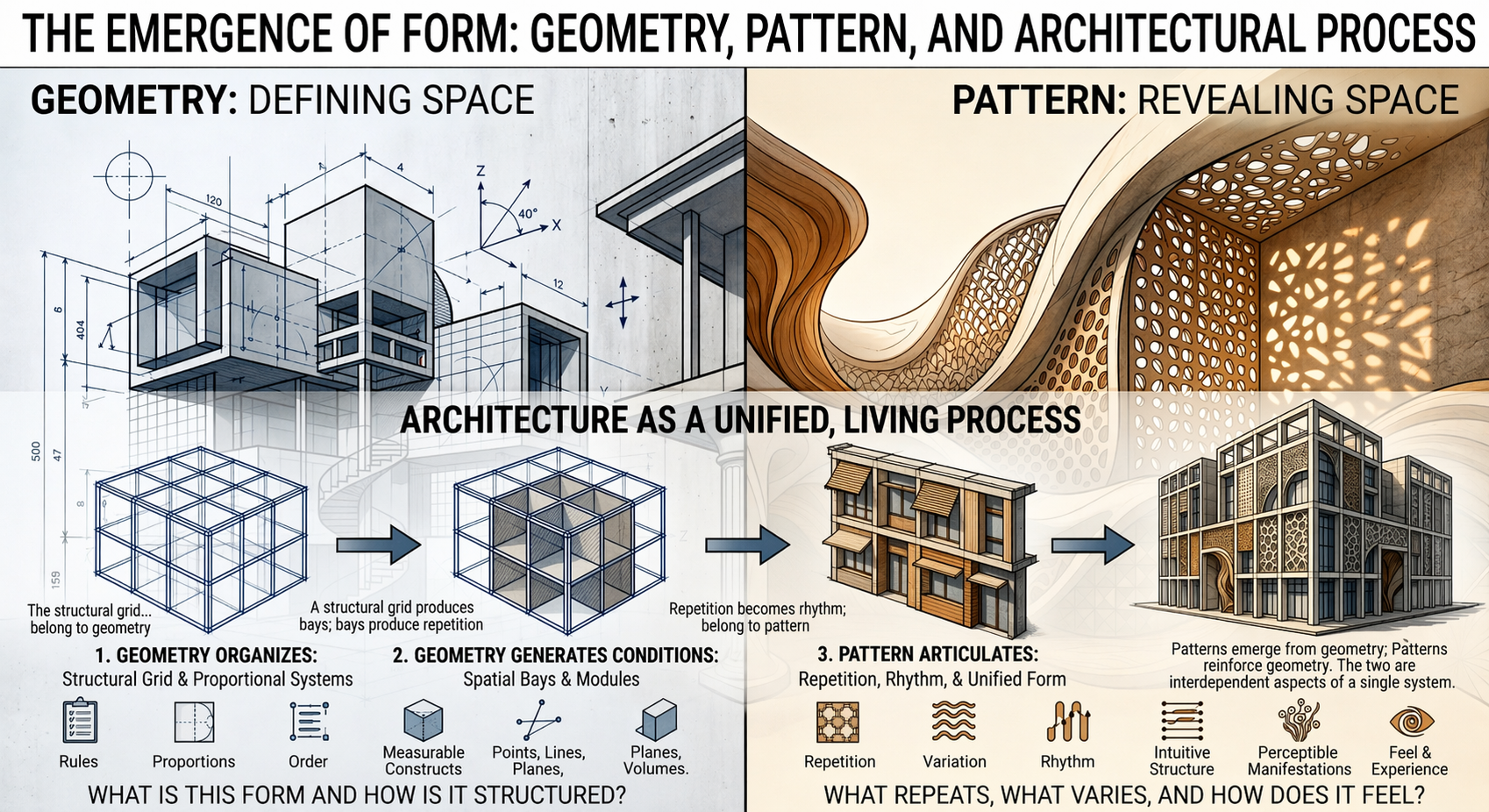
Architecture begins with a distinction that appears simple but proves foundational: the difference between geometry and pattern. Geometry, in its most rigorous sense, is the discipline that defines space through formal relationships. It operates through rules, proportions, and measurable constructs—points, lines, planes, and volumes organized into coherent systems. It is, fundamentally, a language of order. Patterns, by contrast, are not concerned with defining space but with revealing it. They are the perceptible manifestations of repetition, variation, and rhythm—structures that can be recognized intuitively, often before they are understood analytically. Where geometry asks, “What is this form and how is it structured?”, pattern asks, “What repeats, what varies, and how does it feel?”
In architecture, this distinction becomes operational. Geometry is what organizes the building; pattern is what articulates it. The structural grid, the proportional system, the alignment of axes—these belong to geometry. The repetition of windows, the rhythm of columns, the modulation of light across a surface—these belong to pattern. Yet this separation, while useful, is incomplete. Patterns do not simply sit on top of geometry; they emerge from it. A structural grid produces bays; bays produce repetition; repetition becomes rhythm. Geometry generates the conditions under which a pattern appears. At the same time, patterns reinforce geometry by making its order legible to perception. The two are not independent domains but interdependent aspects of a single system.