11. Material Constraints and the Evolution of Geometric Order
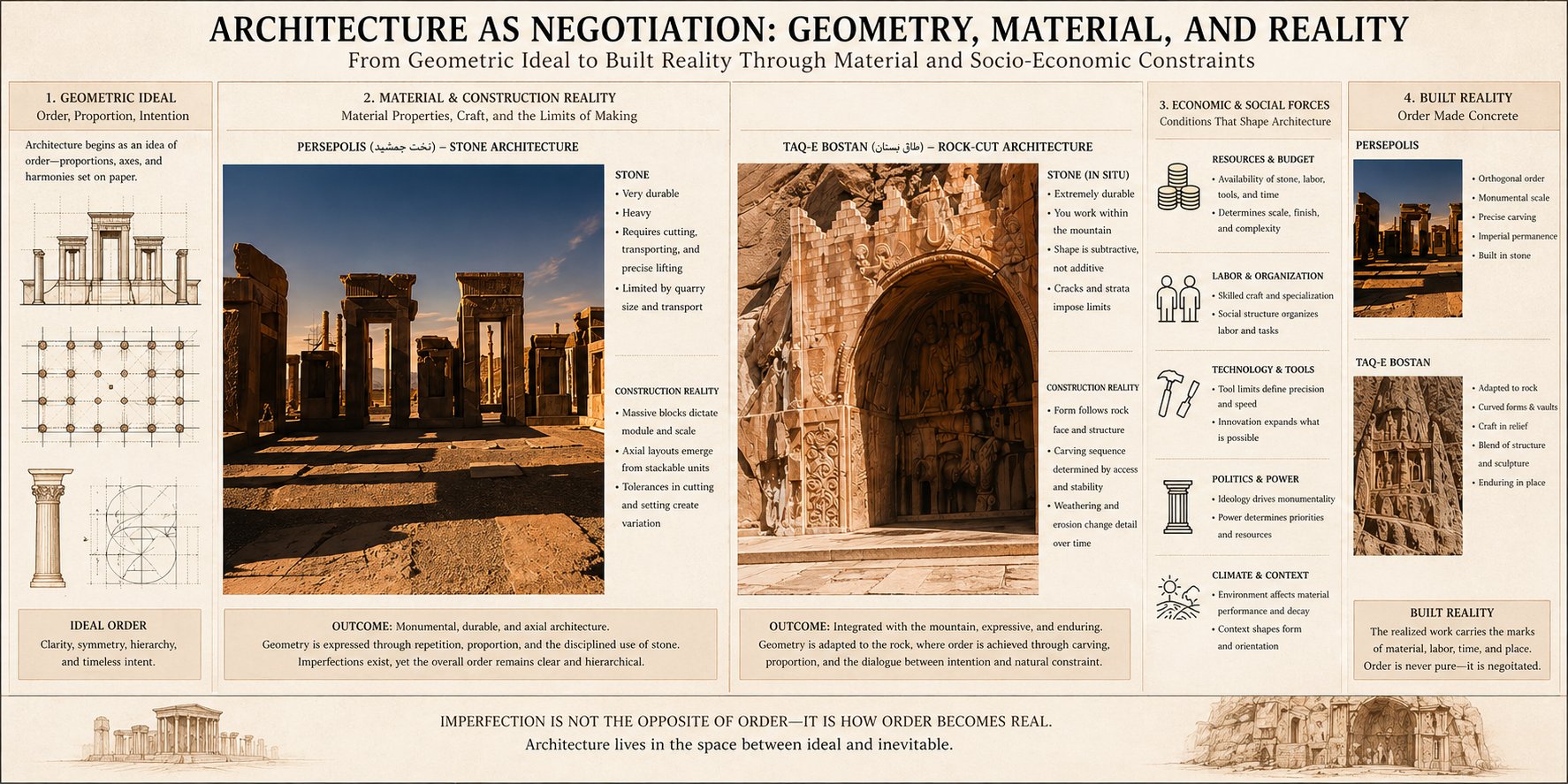
[The Persepolis (تخت جمشید) & Taq-e Bostan (طاقبستان), Material Constraint]
-
To achieve this architectural reality, geometric ideals—no matter how resonant or perfectly proportioned—must ultimately be subjected to the friction of the physical world. Economic and social forces introduce a critical layer of transformation that operates alongside, and often in tension with, formal design intent. Architecture is never produced in an abstract vacuum; it is conditioned by budgets, labor systems, material supply chains, and available construction technologies. These constraints do not simply limit design—they actively shape it. Geometry, in this context, becomes a tool of negotiation. It tends toward modularity, repetition, and efficiency because these qualities align with economic logic and construction feasibility. Regular grids, proportional systems, and repeatable units are not only aesthetic choices; they are responses to scarcity, labor organization, and the need for buildability.
Materiality anchors this entire process in physical reality. Geometry, as conceived in drawings or proportional diagrams, must ultimately be translated into matter—into stone, mud, brick, timber, or tile. Each material carries inherent properties: weight, compressive strength, tensile limits, workability, and weathering behavior. These properties impose their own logic on form. The act of construction introduces tolerance, irregularity, and variation, transforming ideal geometry into something contingent and tactile. Craft plays a decisive role here, mediating between abstract order and material execution. It is through craftsmanship that geometry becomes legible in-built form, and through imperfection that it acquires depth and character.
This relationship between material and geometry becomes especially evident when comparing architectural traditions that evolved in response to shifts in available resources and construction techniques. Early monumental architecture built in stone—such as Persepolis (تخت جمشید) and Taq-e Bostan (طاقبستان)—demonstrates a geometry rooted in mass, permanence, and precise carving. Stone construction favors orthogonal clarity, axiality, and monumentality. Columns, terraces, and carved reliefs emerge from the logic of cutting and stacking large blocks. The geometry here is often hierarchical and static, emphasizing durability and imperial order.
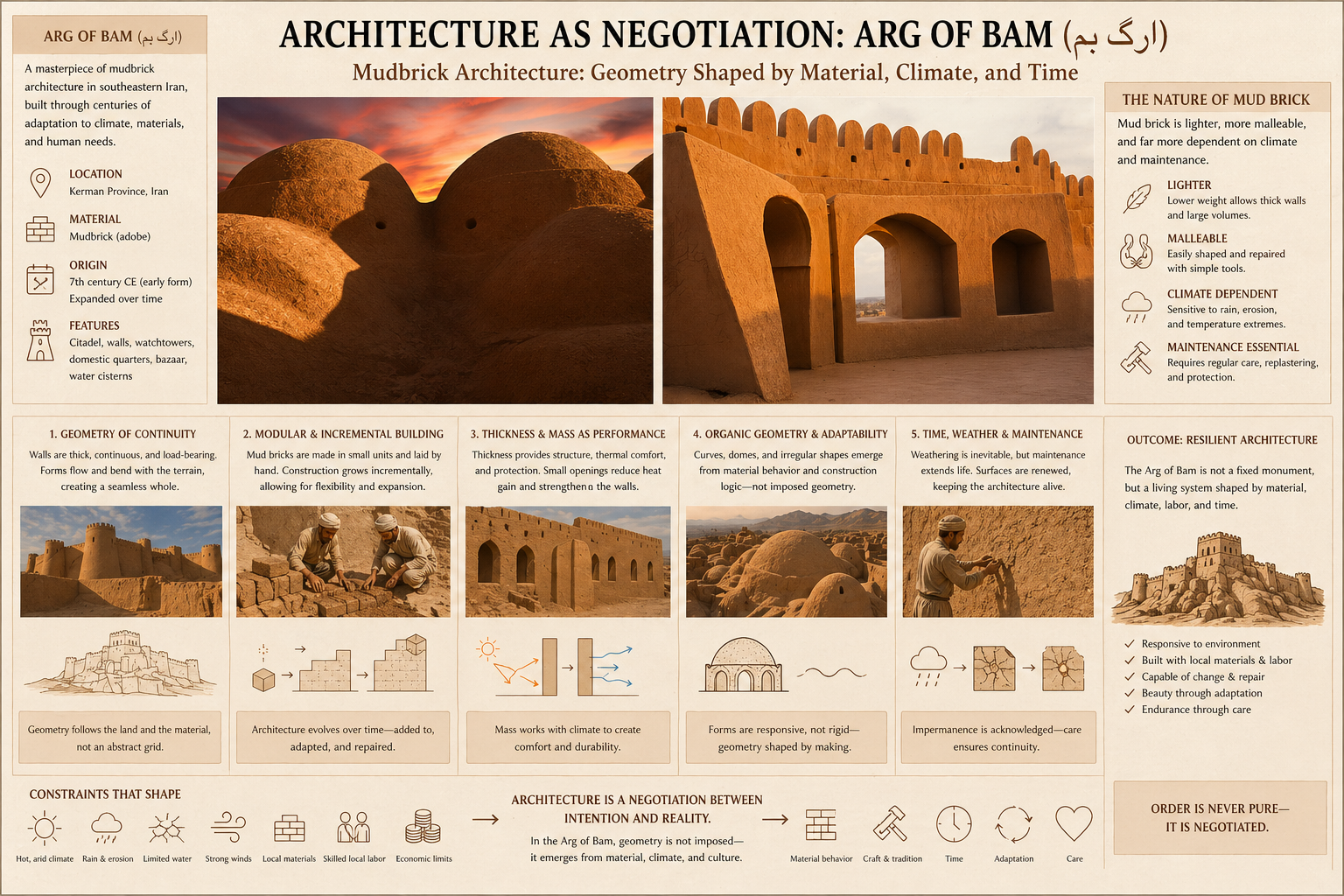
[The Arg of Bam (ارگ بم), Material Constraint]
-
By contrast, mudbrick construction—as seen in the Arg of Bam (ارگ بم)—operates within a very different material regime. Mudbrick is lighter, more malleable, and far more dependent on climate and maintenance. Its geometry tends toward thickness, continuity, and plasticity. Walls become massive and load-bearing, corners soften, and forms adapt to incremental construction processes. The modular nature of mudbrick units encourages repetition, but also allows for organic growth and adaptation over time. The resulting geometry is less rigidly monumental and more responsive, capable of expansion, repair, and transformation.
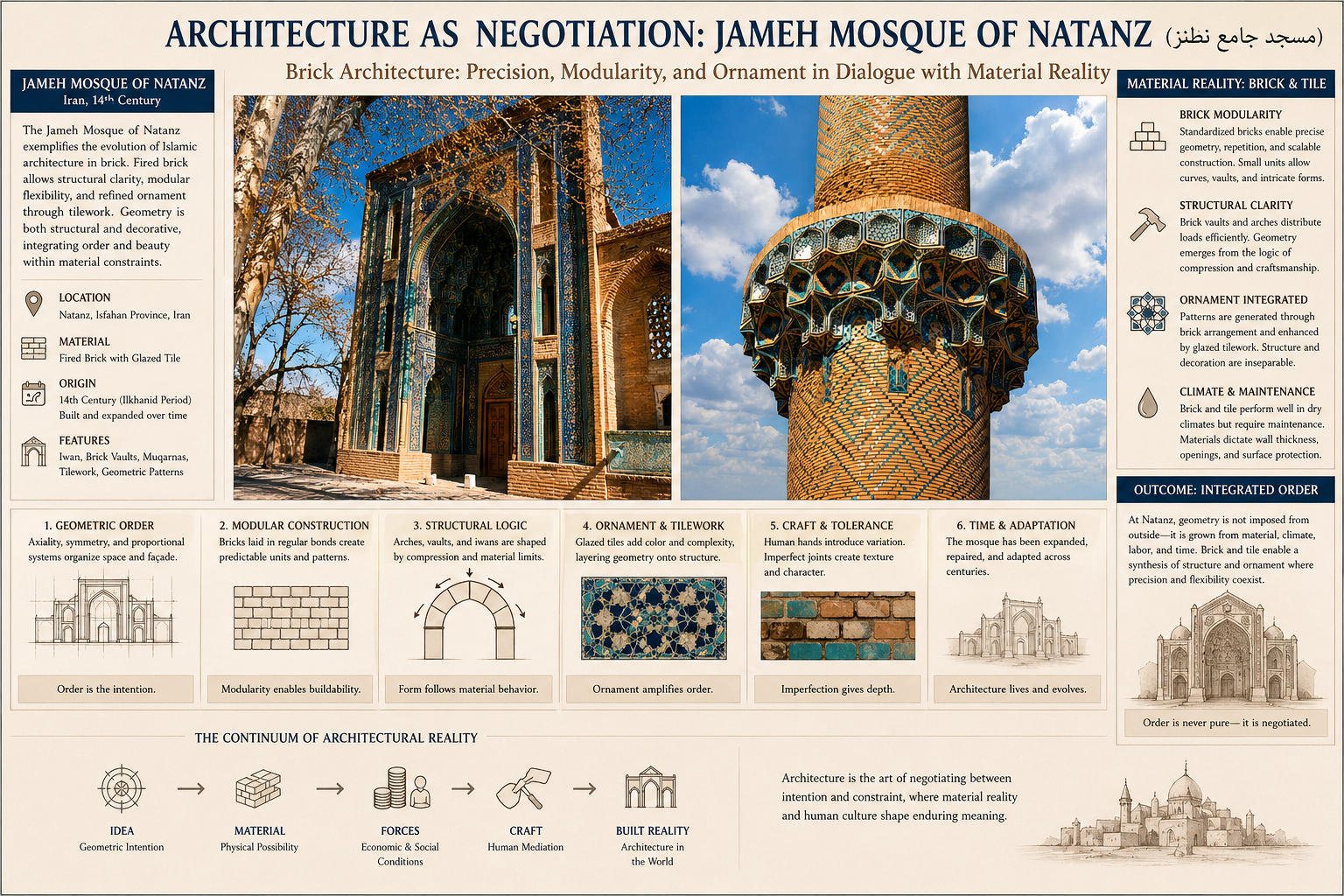
[The Jameh Mosque of Natanz (مسجد جامع نطنز), Material Constraint]
-
Brick construction, particularly in later Islamic architecture such as the Jameh Mosque of Natanz (مسجد جامع نطنز), represents a further evolution. Fired brick introduces greater durability and precision while retaining modular flexibility. This enables a synthesis of structural clarity and decorative articulation. Geometry becomes both structural and ornamental: patterns emerge through the arrangement of bricks themselves, and surfaces are further elaborated with tilework. The introduction of glazed tile allows color and pattern to amplify geometric order, producing highly refined compositions where structure and ornament are deeply integrated.
These transitions—from stone to mudbrick to fired brick—demonstrate how material shifts generate distinct geometric languages. Stone privileges permanence and exactitude; mudbrick enables adaptability and mass continuity; brick allows for modular precision and intricate patterning. Each material system carries its own constraints and opportunities, shaping not only how buildings are constructed but how space is conceived and experienced.
What ties these examples together is the persistence of geometry as a conceptual framework, even as its expression changes. Across Persepolis (تخت جمشید), Naqsh-e Rostam (نقش رستم), Arg of Bam (ارگ بم), and the Jameh Mosque of Natanz (مسجد جامع نطنز), geometry remains central—but it is continuously reinterpreted through material, technique, and social context. Architecture, therefore, should be understood not as the application of fixed geometric ideals, but as an evolving dialogue between abstract order and material reality, shaped by economic conditions, cultural practices, and the contingencies of construction.