9. The Geometry of the Unseen: Experiencing Architecture Beyond the Visual
-
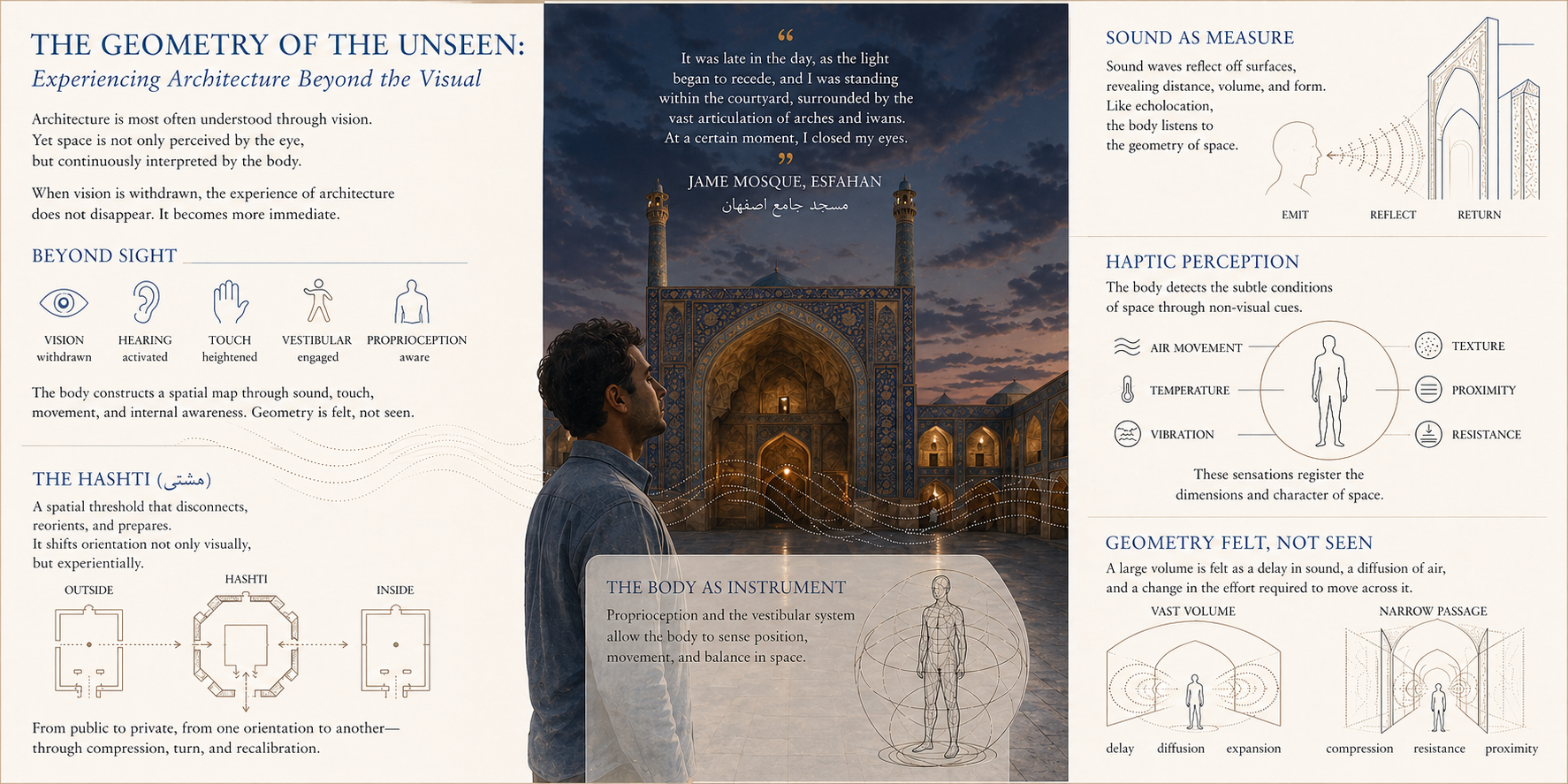
While the hashti (هشتی) of the Shah Mosque in Isfahan demonstrates how space can physically and symbolically reorient its inhabitants, it also reveals a broader truth about spatial perception. Architecture is most often understood through vision. Plans, elevations, and perspectives all reinforce the assumption that space is something to be seen, measured, and composed visually. Yet this reliance on sight obscures a more fundamental condition: that space is not only perceived by the eye, but continuously interpreted by the body.
When vision is withdrawn—when the eyes are closed—the experience of architecture does not disappear. On the contrary, it becomes more immediate. The body begins to register its surroundings through other sensory systems, constructing a spatial awareness that operates independently of visual confirmation. This condition, though rarely addressed in architectural discourse, reveals another dimension of geometry—one that cannot be drawn, yet can be deeply felt.
Certain species navigate entirely through sound, using echolocation to measure distance and form. Similarly, many individuals who are blind develop an acute sensitivity to the reflections of sound in space. Even for those accustomed to visual dominance, closing the eyes activates a latent awareness. Proprioception—the body’s internal sense of position—works in concert with auditory, tactile, and vestibular systems to construct an alternative spatial map. Geometry, in this sense, is no longer a configuration of lines and surfaces, but a field of relationships perceived through the body.
Haptic perception plays a central role in this process. It extends beyond the simple act of touch, encompassing the body’s active engagement with its environment—the detection of air movement, the subtle variations in temperature, the faint vibrations of surfaces underfoot. These sensations allow the dimensions of a space to be registered without sight. A large volume is not only seen as expansive; it is also felt as a delay in sound, a diffusion of air, and a change in the effort required to move across it. A narrow passage is sensed through compression, resistance, and proximity.
[Jame Mosque Isfahan (مسجد جامع اصفهان), Geometry of the Unseen]
-
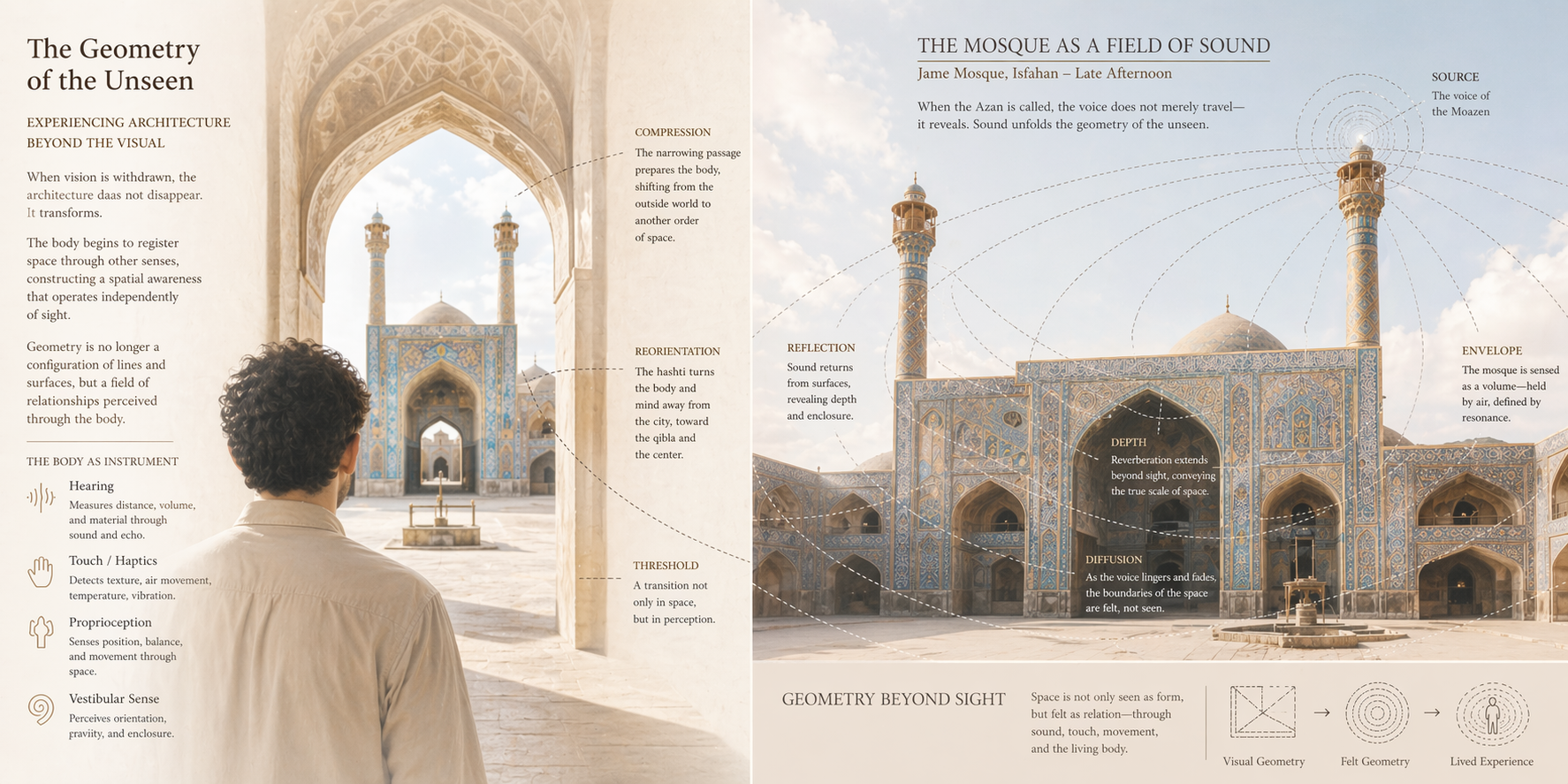
I became acutely aware of this phenomenon during a visit to the Jame Mosque in Esfahan (اصفهان). It was late in the day, as the light began to recede, and I was standing within the courtyard, surrounded by the vast articulation of arches and iwans (ایوان). At a certain moment, I closed my eyes. What followed was not an absence of space, but its transformation. The geometry that had been visually apprehended gave way to another form of understanding.
When the Azan (اذان) was called by the Moazen (مؤذن), his voice filled the courtyard, extending far beyond the limits of sight. The sound did not simply travel; it unfolded, revealing depth through its reverberation. The continuity of the voice, its return from distant surfaces, its gradual dissipation—all of these conveyed the scale of the space with a clarity that surpassed visual perception. The architecture could be sensed as a volume, as a field of distances and reflections, rather than as a collection of forms. The words themselves receded in importance; what remained was the spatial presence of sound.
In that moment, geometry revealed itself as something other than an arrangement of points, lines, and planes. It emerged as a relational condition—an invisible structure that could be experienced but not seen. This is what might be called the geometry of the unseen.
Ali Qapu palace Isfahan (عالیقاپو), Geometry of the Unseen]
-
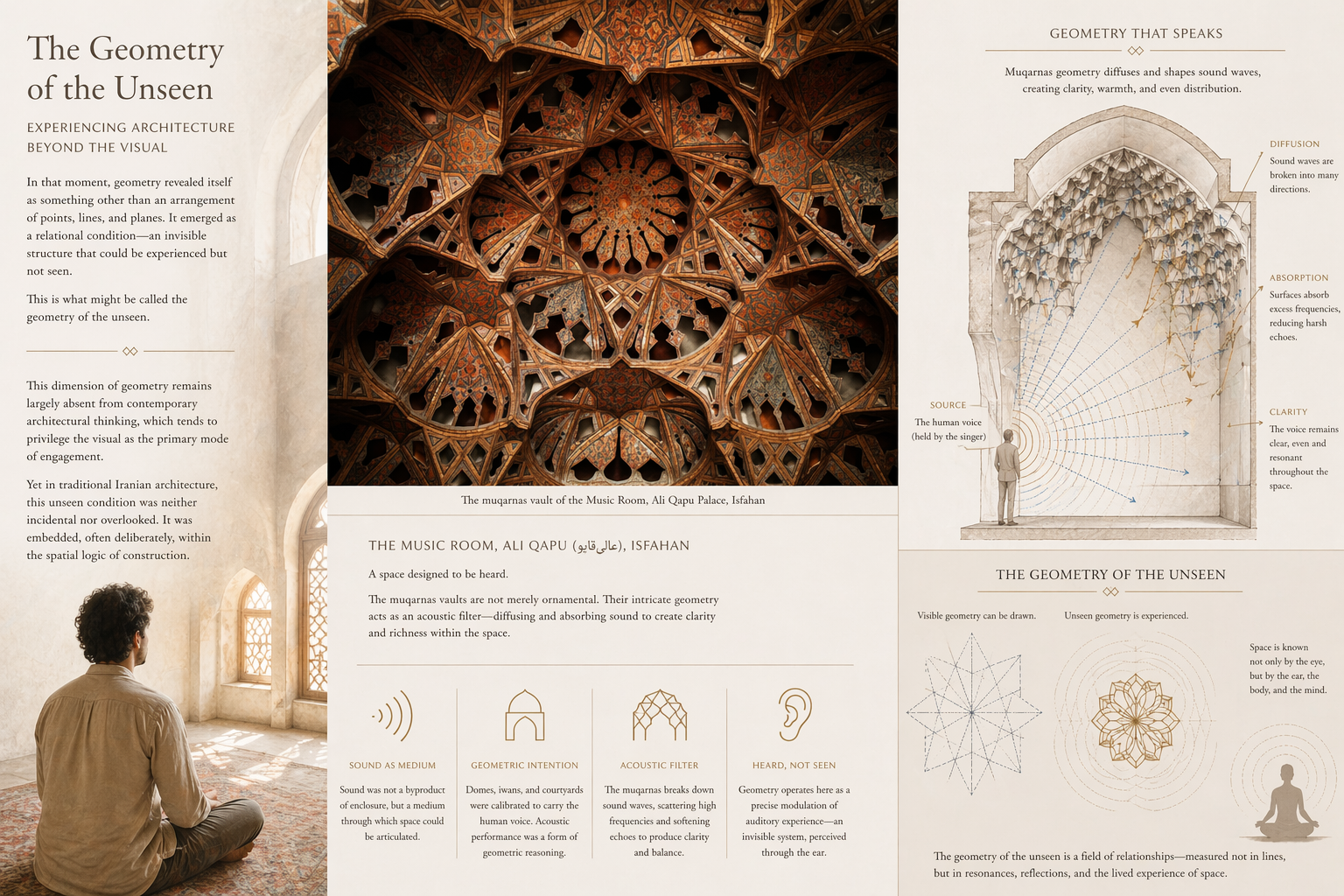
This dimension of geometry remains largely absent from contemporary architectural thinking, which tends to privilege the visual as the primary mode of engagement. Yet in traditional Iranian architecture, this unseen condition was neither incidental nor overlooked. It was embedded, often deliberately, within the spatial logic of construction.
Sound, for instance, was not treated as a byproduct of enclosure, but as a medium through which space could be articulated. The curvature of domes, the proportions of iwans, and the configuration of enclosed courtyards were frequently calibrated to carry the human voice. The acoustic performance of these spaces was not accidental; it was a form of geometric reasoning, translated into material form.
A particularly refined example can be found in the Music Room of the Ali Qapu (عالیقاپو) palace in Esfahan. The muqarnas (مقرنس) vaults carved into its surfaces are often understood as ornamental, yet their function extends far beyond visual decoration. Their complex geometry acts as an acoustic filter, diffusing and absorbing sound to create clarity within the space. Here, geometry operates as a precise modulation of auditory experience—an invisible system, perceived through the ear rather than the eye.
[The Shabestan (شبستان) Naeen, Geometry of the Unseen]
-
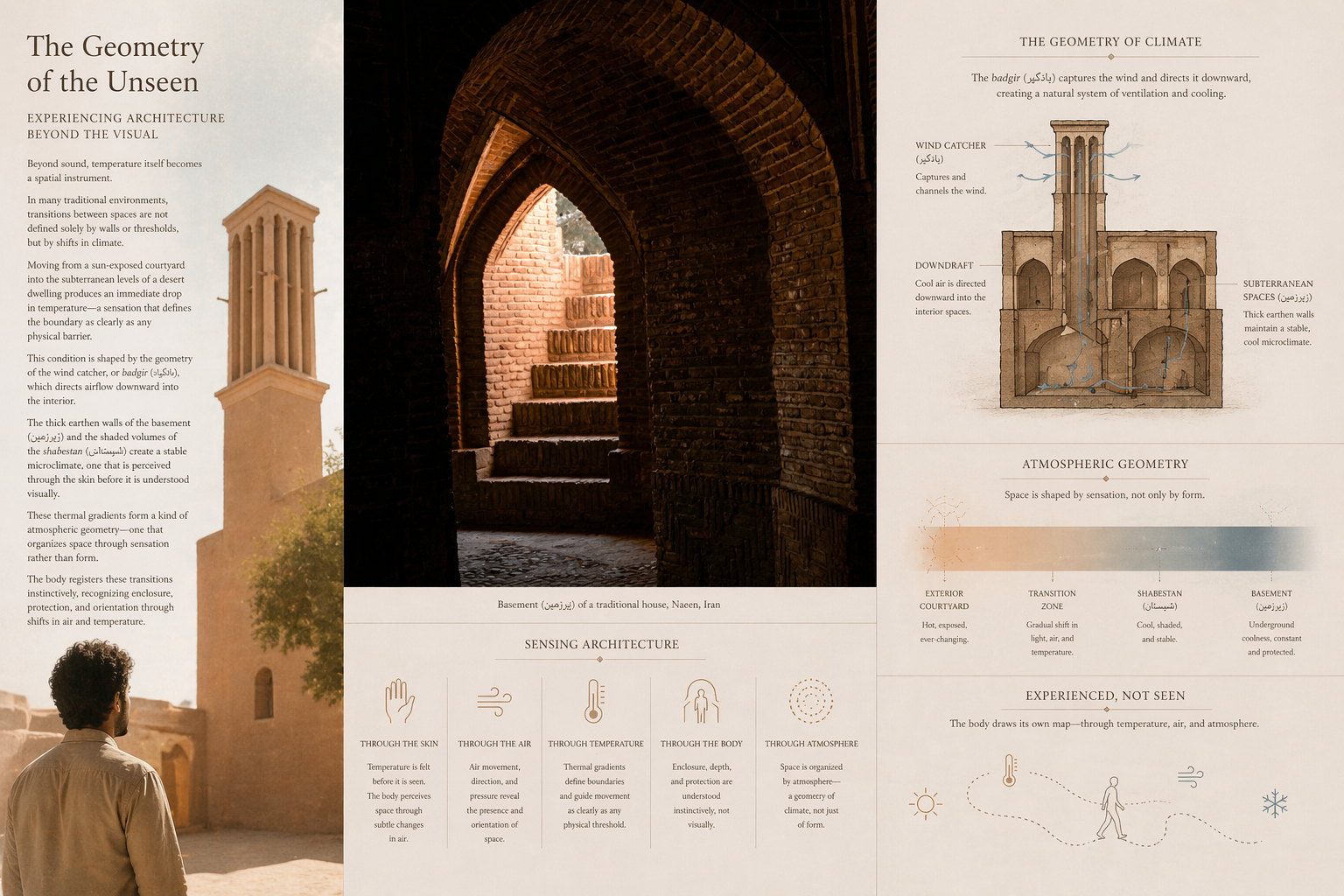
Beyond sound, temperature itself becomes a spatial instrument. In many traditional environments, transitions between spaces are not defined solely by walls or thresholds, but by shifts in climate. Moving from a sun-exposed courtyard into the subterranean levels of a desert dwelling produces an immediate drop in temperature—a sensation that defines the boundary as clearly as any physical barrier. This condition is shaped by the geometry of the wind catcher, or badgir (بادگیر), which directs airflow downward into the interior. The thick earthen walls of the basement (زیرزمین) and the shaded volumes of the shabestan (شبستان) create a stable microclimate, one that is perceived through the skin before it is understood visually.
These thermal gradients form a kind of atmospheric geometry—one that organizes space through sensation rather than form. The body registers these transitions instinctively, recognizing enclosure, protection, and orientation through shifts in air and temperature.
[ Pish-khān (پیشخان) & Hashti (هشتی), Geometry of the Unseen]
-
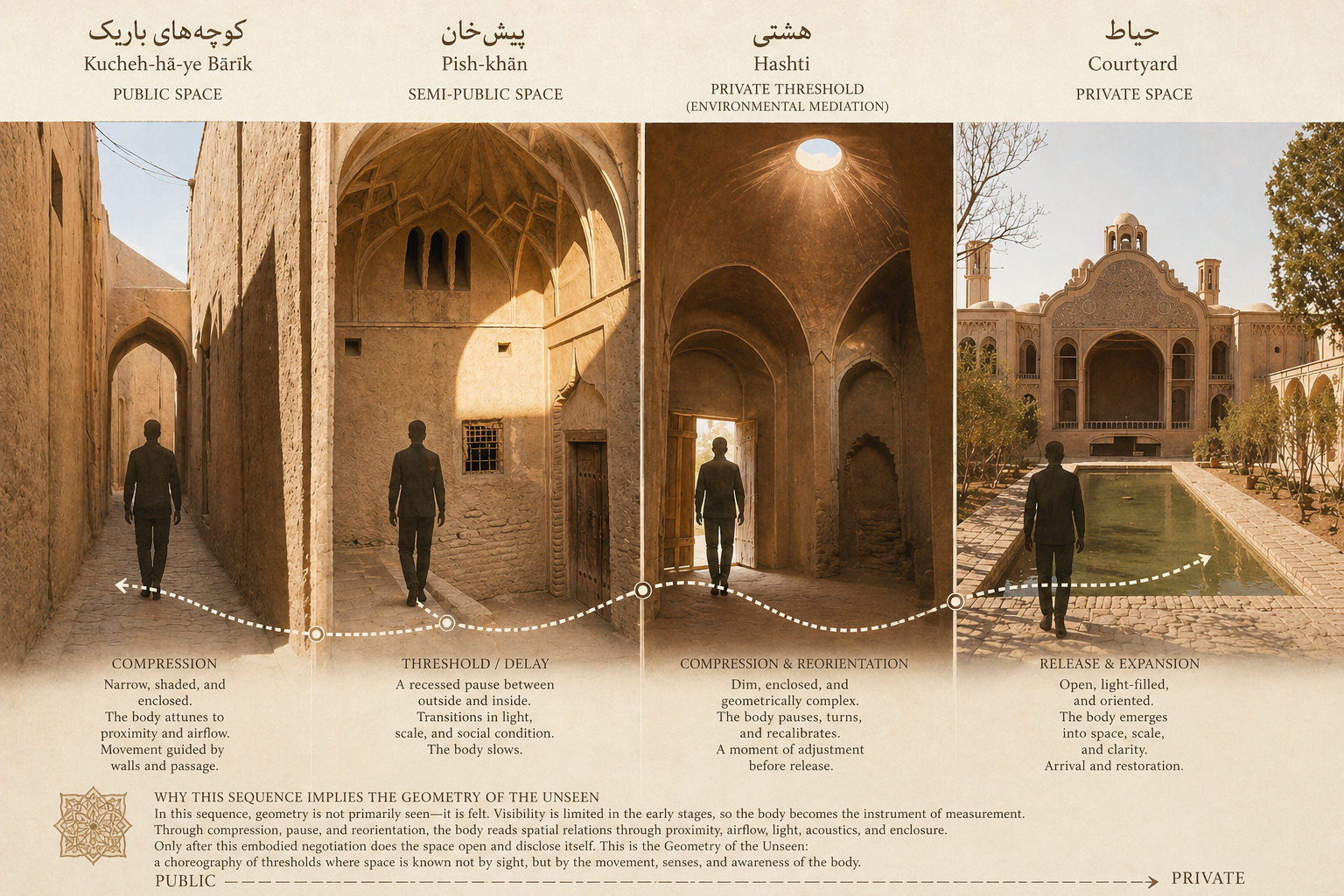
Movement further reinforces this non-visual reading of space. In environments where visibility is limited, the body itself becomes the primary instrument of measurement. This is evident in the narrow alleys, or koocheh (کوچه), of desert cities such as Yazd, where high walls and compressed passages guide movement through proximity and airflow. The geometry is not merely seen; it is navigated through bodily awareness.
This kinetic understanding of space reaches a particularly articulate expression at the entrance of the traditional Iranian house. Passing from the alley into the hashti (هشتی), the body is forced into a moment of pause and reorientation. The space is often dim, enclosed, and geometrically complex, requiring subtle adjustments in movement. Only after this compression does the body emerge into the open courtyard, where light, scale, and orientation are suddenly restored.
This sequence—compression followed by release—constitutes a form of choreographed geometry. It is not experienced visually as a diagram, but physically, through the rhythms of movement and the shifting conditions of space. The transition from public to private is not only marked by walls, but enacted through the body itself.
To recognize these dimensions—acoustic, thermal, haptic, and kinetic—is to acknowledge that architecture operates across multiple layers of perception. Geometry, in this expanded sense, is not confined to visible form. It extends into the invisible structures that shape experience, guiding the body through space even in the absence of sight.
Traditional Iranian architecture, in this light, cannot be understood as an object to be viewed from a distance. It is an environment to be inhabited, sensed, and physically engaged. Its geometry is not limited to what can be drawn or measured; it resides equally in what can be heard, felt, and remembered.
The unseen, therefore, is not secondary to architecture. It is one of its most fundamental dimensions.