10. The Geometry of Imperfection: Adaptation and Authenticity in Traditional Arts
[ Persian carpet, The Geometry of Imperfection]
-
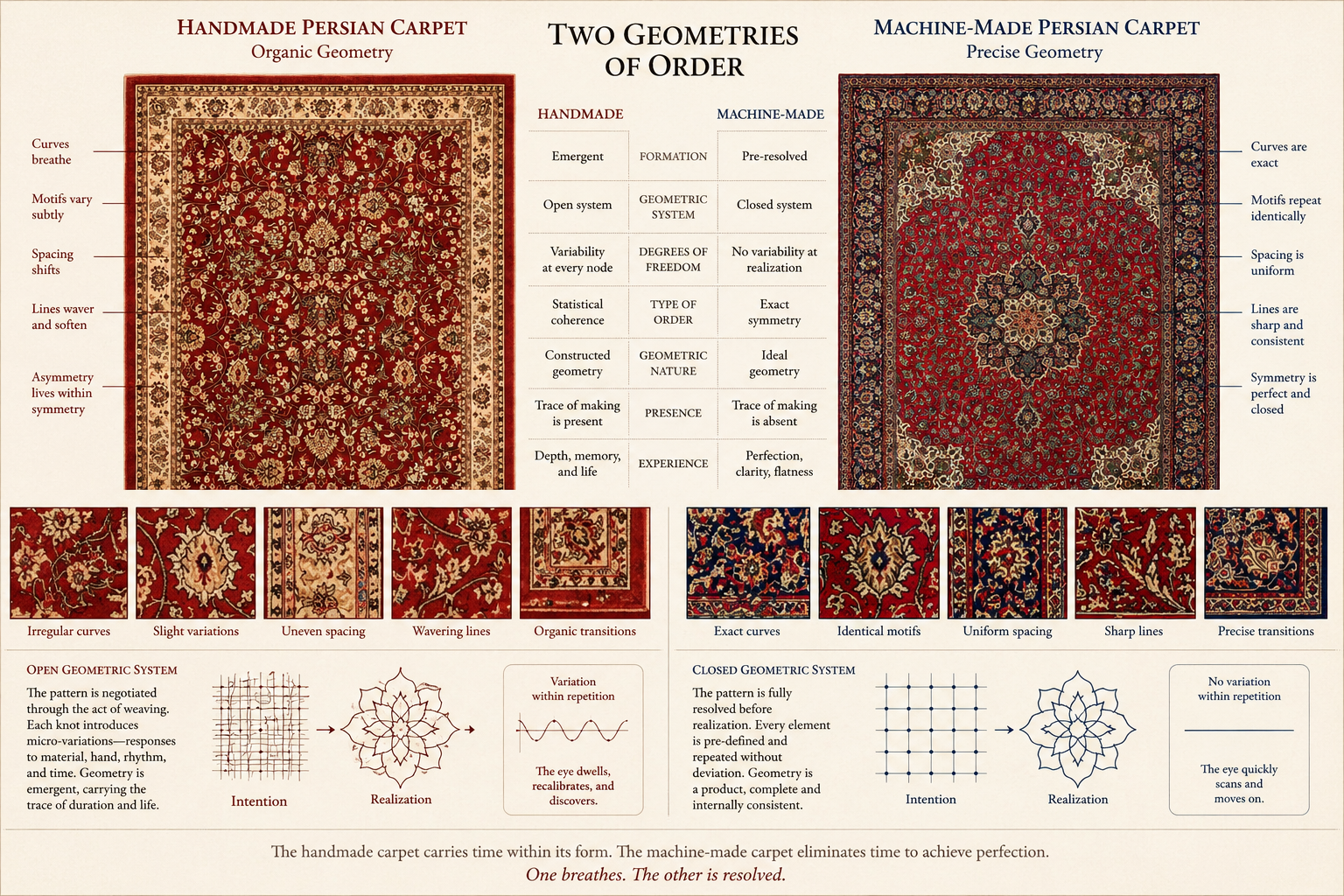
I recall, from early childhood, a quiet but persistent discomfort with the gradual appearance of machine-made Persian carpets in Iran. Their presence, which became more widespread in the 1960s with the acceleration of industrial production, did not immediately signal any problem. On the contrary, these carpets were often celebrated for their precision—their exact repetition of traditional motifs, their clarity of line, their flawless execution. Yet even then, something felt unsettled. I lacked the language to articulate it, but the feeling remained: these objects, though visually correct, seemed somehow incomplete.
Only later did it become evident that what they lacked was not technical skill, but a certain kind of presence. The geometry embedded in these machine-made carpets was too resolved, too exact, too closed upon itself. It achieved perfection in the mathematical sense, yet in doing so, it eliminated the subtle irregularities through which form acquires depth, memory, and life. What was absent was not order, but the trace of its making.
In formal geometry education, we are taught to understand form through absolute definitions. A circle is valid only insofar as all its points remain equidistant from a center; the slightest deviation negates its existence as a circle. Parallel lines must maintain constant separation indefinitely; any divergence collapses the condition itself. Geometry, in this framework, operates as a system of exactness, where precision is not only desired but required, and where deviation is treated as failure.
Yet this conception of geometry, while indispensable within mathematics, proves insufficient when confronted with the realities of art, craft, and architecture. In these domains, geometry does not exist in isolation. It is not an abstract construct suspended outside of time and material, but a condition that must engage with them. Within the traditions of Iranian craftsmanship and architecture, geometry is not imposed as an ideal; it is negotiated as a response.
[The Jameh Mosque of Natanz (مسجد جامع نطنز), The Geometry of Imperfection]
-
The unease provoked by machine-made carpets can thus be understood as a response to their closure. The machine produces a finished object, one that leaves no room for variation, adjustment, or dialogue. Its geometry is fixed, complete, and indifferent to context. By contrast, the handmade artifact remains open. It carries within it the subtle adjustments of the hand, the slight inconsistencies of material, the small but meaningful deviations that emerge through the act of making. These irregularities do not weaken the work; they animate it. They serve as evidence that the object has passed through time, through labor, through human intention.
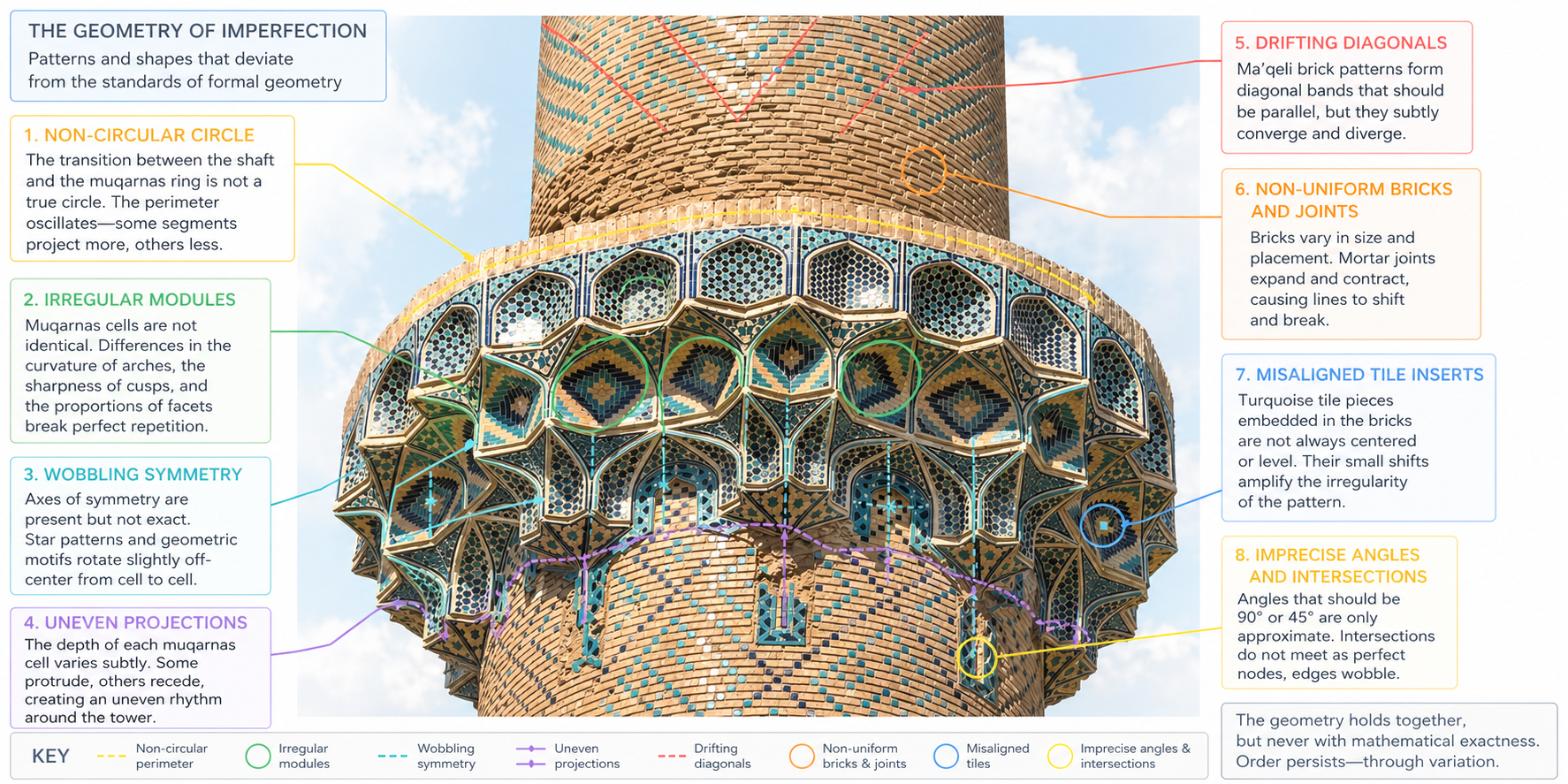
This condition is not limited to textiles. It is equally present in the architectural traditions shaped by similar logics of making. In the intricate configurations of Ma’qeli (معقلی) brickwork, in the layered articulation of Muqarnas (مقرنس), or in the patterned surfaces of banna’i (بنایی) construction, one encounters geometries that are rigorous yet never mechanically exact. At first glance, they appear governed by strict mathematical order, yet closer observation reveals subtle variations—slight shifts in alignment, differences in surface texture, irregularities in the reflection of light. These are not errors to be corrected; they are integral to the work’s vitality. The geometry holds together, but it does so without eliminating difference.
[ yakhchal (یخچال) in Kerman, Iran, The Geometry of Imperfection]
-
The distinction here is not between geometry and its absence, but between two fundamentally different modes of understanding it. In mathematics, geometry operates as an absolute system, defined independently of circumstance. In architecture, however, geometry must confront the contingencies of the physical world. It must accommodate the irregularities of land, the constraints of construction, the demands of climate, and the patterns of human use. It cannot remain pure without becoming irrelevant.
Traditional built environments demonstrate this condition with particular clarity. The geometry of a karbandi (کاربندی) ceiling, for instance, does not emerge from an abstract diagram alone; it is shaped by span, structure, and the limits of material assembly. A courtyard does not always conform to ideal proportions when the boundaries of a site or the sun's orientation require adjustment. Even more telling is the spatial continuity of the traditional bazaar, where vaulted forms extend across winding paths that resist linear order. The sequence of tāq (طاق) and dome does not impose a rigid axis; it adapts to the movement of the koocheh (کوچه), bending and recalibrating in response to its course. Geometry, in these cases, is neither abandoned nor strictly enforced. It is transformed into a relational system—one that derives its coherence not from perfection, but from its capacity to adjust.
This relational condition extends beyond spatial organization into the deeper question of how architecture situates itself within the world. In many traditional and philosophical frameworks, perfection is understood as an abstract ideal, belonging to a realm beyond material existence. The physical world, by contrast, is recognized as contingent, subject to change, and inherently incomplete. To insist upon absolute perfection within it is to misunderstand its nature.
Within this context, what is often described as imperfection takes on a different meaning. It becomes a form of inclusion—an acknowledgment of forces that cannot be entirely controlled or resolved. The slight asymmetry in a patterned surface, the gradual erosion of a wall, the deformation of a line under structural or environmental pressure—these are not deficiencies, but signs of participation in a larger system. They indicate that the work is not isolated, but engaged.
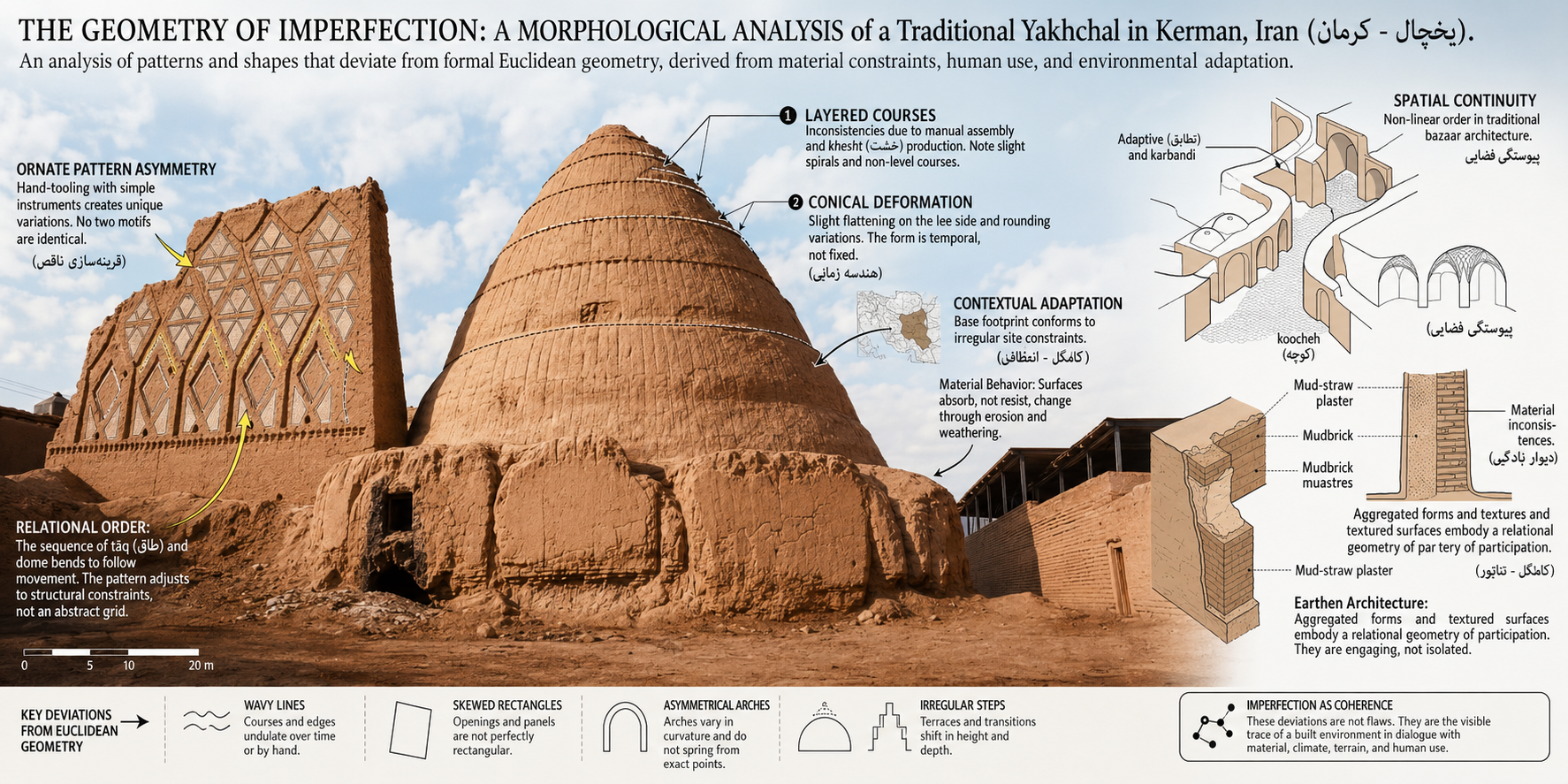
Earthen architecture offers one of the most direct expressions of this condition. Structures built from khesht (خشت) and finished with kahgel (کاهگل) do not resist transformation; they absorb it. Their surfaces shift over time, their edges soften, their geometries adapt subtly under the influence of climate and gravity. The domes of a yakhchal (یخچال), or the aggregated forms of desert settlements, do not maintain strict Euclidean clarity. Instead, they achieve a different kind of order—one that is aligned with environmental performance, material behavior, and human habitation. Their geometry is not fixed; it is temporal.
-
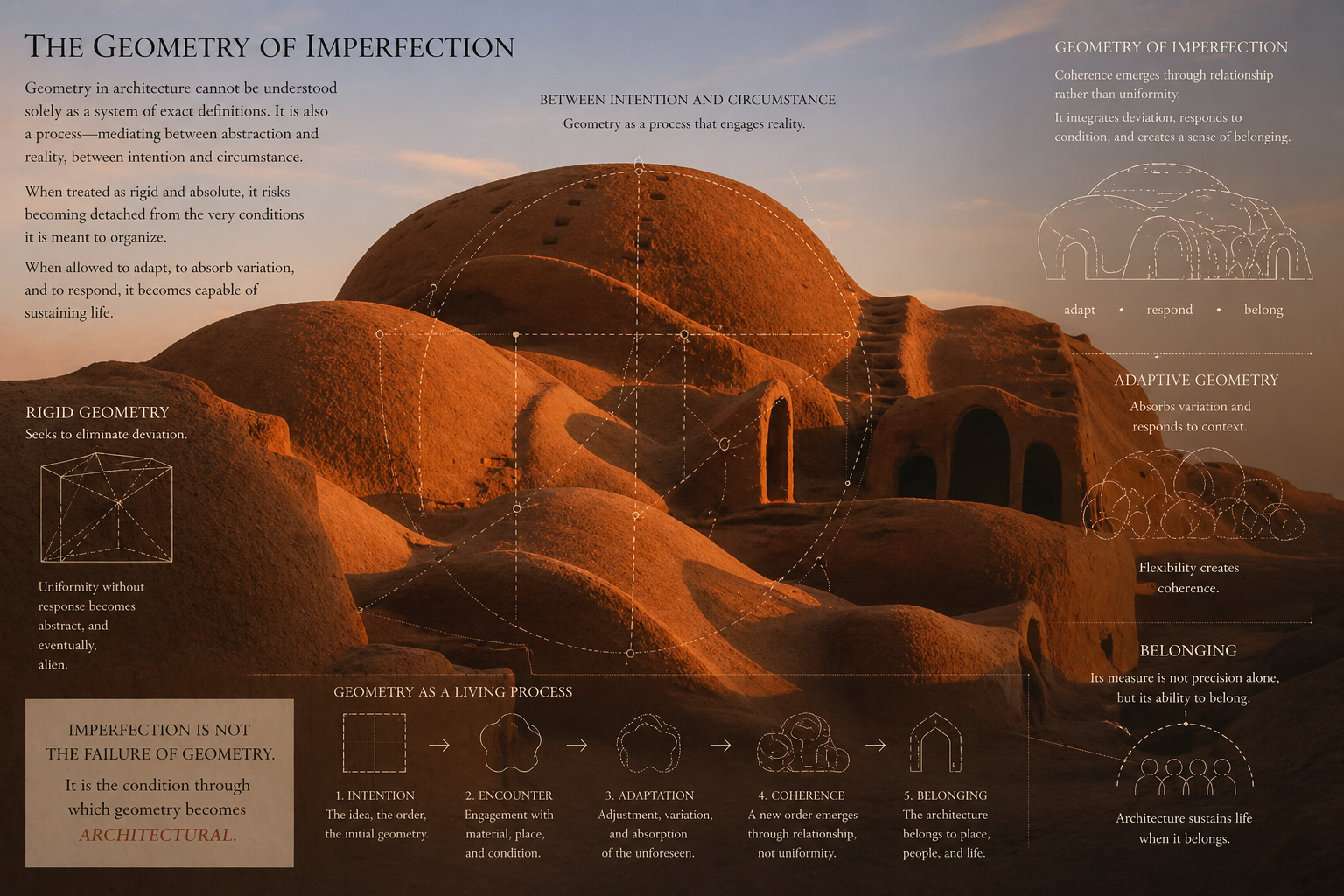
What emerges from these observations is not a rejection of geometry, but a reconsideration of its role. Geometry, within architecture, cannot be understood solely as a system of exact definitions. It must also be recognized as a process—one that mediates between abstraction and reality, between intention and circumstance. When it is treated as rigid and absolute, it risks becoming detached from the very conditions it is meant to organize. When it is allowed to adapt, to absorb variation, and to respond, it becomes capable of sustaining life.
This is what might be called a geometry of imperfection. It is not defined by the absence of order, but by a different conception of it—one in which coherence emerges through relationship rather than uniformity. It does not seek to eliminate deviation, but to integrate it. Its measure is not precision alone, but its ability to belong.
In this sense, imperfection is not the failure of geometry. It is the condition through which geometry becomes architectural.