4. The Geometry of Attraction: Why Natural Forms Resonate with Human Perception.
-
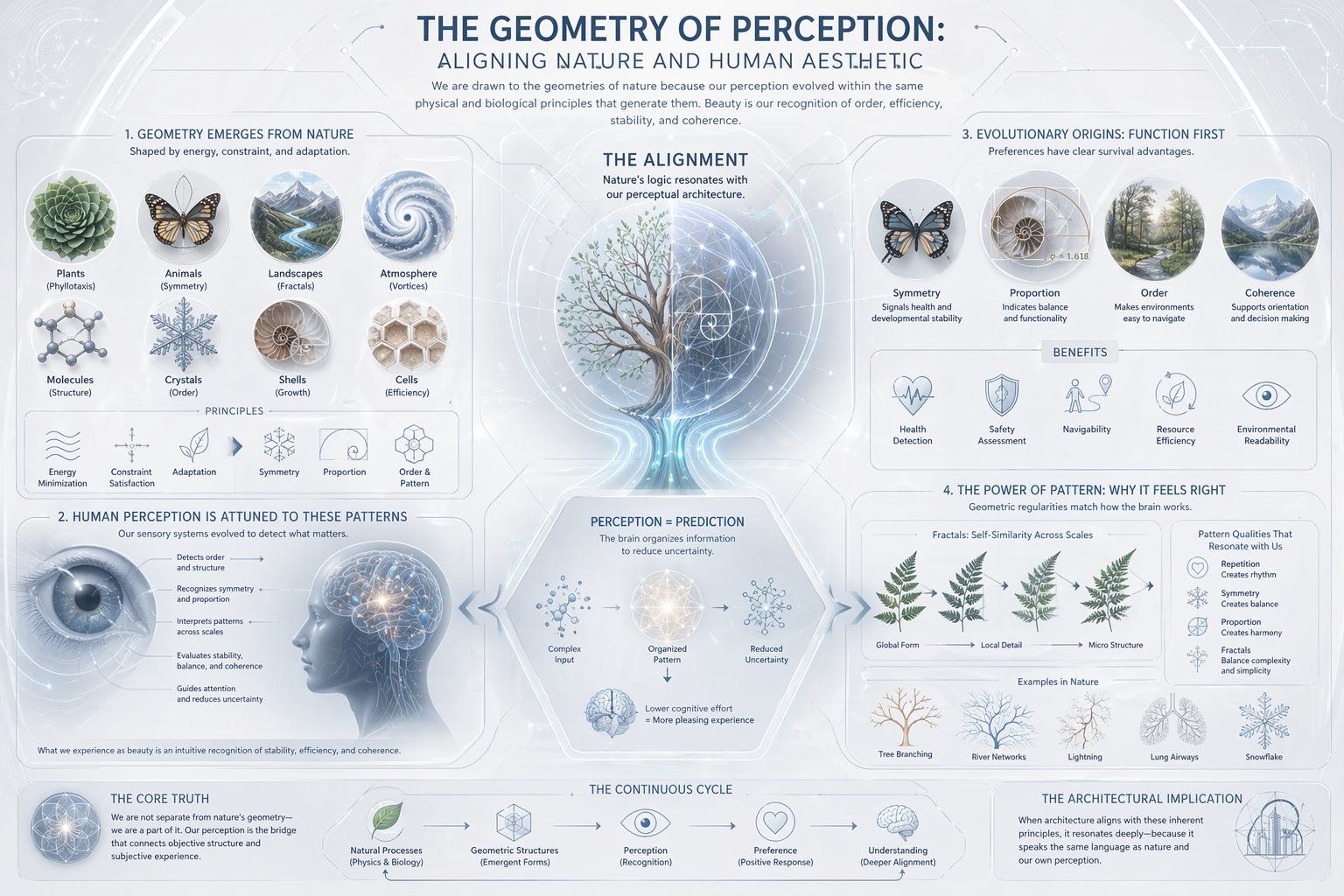
Earlier, we introduced geometry not as an imposed system, but as something that emerges from natural processes—shaped by energy, constraint, and adaptation. This raises a deeper question: why are we, as humans, consistently drawn to these geometries? The answer lies not in subjective taste alone but in a profound alignment between the structures of nature and those of human perception.
Across environments, we are instinctively attracted to forms found in plants, animals, landscapes, and atmospheric patterns. These configurations appear visually pleasing, yet this response is not incidental. It is rooted in the same physical and biological processes that generate them. Human perception evolved within these conditions, and our sensory systems are attuned to recognize patterns that signal stability, efficiency, and coherence. What we experience as beauty is often an intuitive recognition of these qualities.
From an evolutionary standpoint, this preference has clear functional origins. The human visual system evolved to quickly identify order, symmetry, proportion, and pattern—features that often signal health, safety, and navigability. Symmetry in living organisms, for example, can indicate developmental stability, while structured environments are easier to interpret and inhabit. As a result, the brain tends to register such configurations as both legible and reassuring.
At a deeper level, perception operates through pattern recognition and prediction. The brain continuously organizes incoming information to reduce uncertainty. Geometric regularities—repetition, rhythm, proportional scaling—facilitate this process by lowering cognitive effort. Fractal patterns are particularly effective in this regard, offering self-similarity across scales that balances complexity with clarity. This combination is often experienced as both engaging and calming.

-
However, preference does not arise from order alone. Just as in nature, we are drawn to a balance between regularity and variation. Pure randomness overwhelms perception, while rigid uniformity feels inert. The most compelling forms exist between these extremes—structured yet adaptive, ordered yet dynamic. This condition, often described as organized complexity, reflects the logic of natural systems themselves. Ultimately, our aesthetic response is not imposed upon the world but shaped by it. Geometry in nature is compelling because it embodies coherence and efficiency, and human perception—formed within that same framework—is predisposed to recognize and respond to it.
The existence of such perceptual mechanisms is not unique to humans. In nature, similar forms of rule-based behavior produce outcomes that appear remarkably geometric. The intricate sand formations created by certain species of fish, for instance, display radial symmetry and fine-grained patterning without any evidence of abstract reasoning. These structures emerge from repeated actions governed by simple behavioral rules, refined over generations through selection. The resulting forms are not designed in the intellectual sense; they are produced through the interaction of behavior, environment, and evolutionary pressure. What appears as geometry is, in fact, an emergent property of a system—and what we perceive as order is the legibility of that emergence.
At first glance, the images shown below—the biological mating nest meticulously carved into the ocean floor by a tiny pufferfish, and the magnificent architectural dome of Dowlat Abad Garden (باغ دولتآباد) in Yazd, Iran—appear completely unrelated. Yet, visually and mathematically, they are striking examples of the exact same geometric principles. Both designs rely heavily on radial symmetry, with concentric rings expanding outward from a focused central point. They utilize rhythmic repetition, alternating ridges of sand or tessellations of star polygons, to create a solid structure, subdividing the geometry as the circles grow larger to compensate for increased surface area. Although one is driven by natural instinct and the other by human engineering, both are generated by the same algorithmic process based on polar coordination. Every construction begins at a single point of origin. Instead of a standard grid, the creators utilize a radius and an angle. The architect uses compasses to draw intersecting circles and divides angles to form complex stars, while the pufferfish swims outward, tracing a polar coordinate system with its fins. Ultimately, both masterpieces are generated by iterative algorithms, proving that applying simple rules to repeated actions yields highly harmonious visual results in both wild nature and intricate human architecture.
This realization complicates the architect’s role. While humans can formalize geometry, describe it mathematically, and manipulate it with precision, much of design intuition operates more like instinct than explicit calculation. Architecture thus occupies an intermediary domain between instinct and intellect—a synthesis rather than a polarity. Geometry disciplines and sharpens intuition, while intuition directs the application and transformation of geometry.