3. Geometry as Emergence: From Natural Systems to Architectural Form.
-
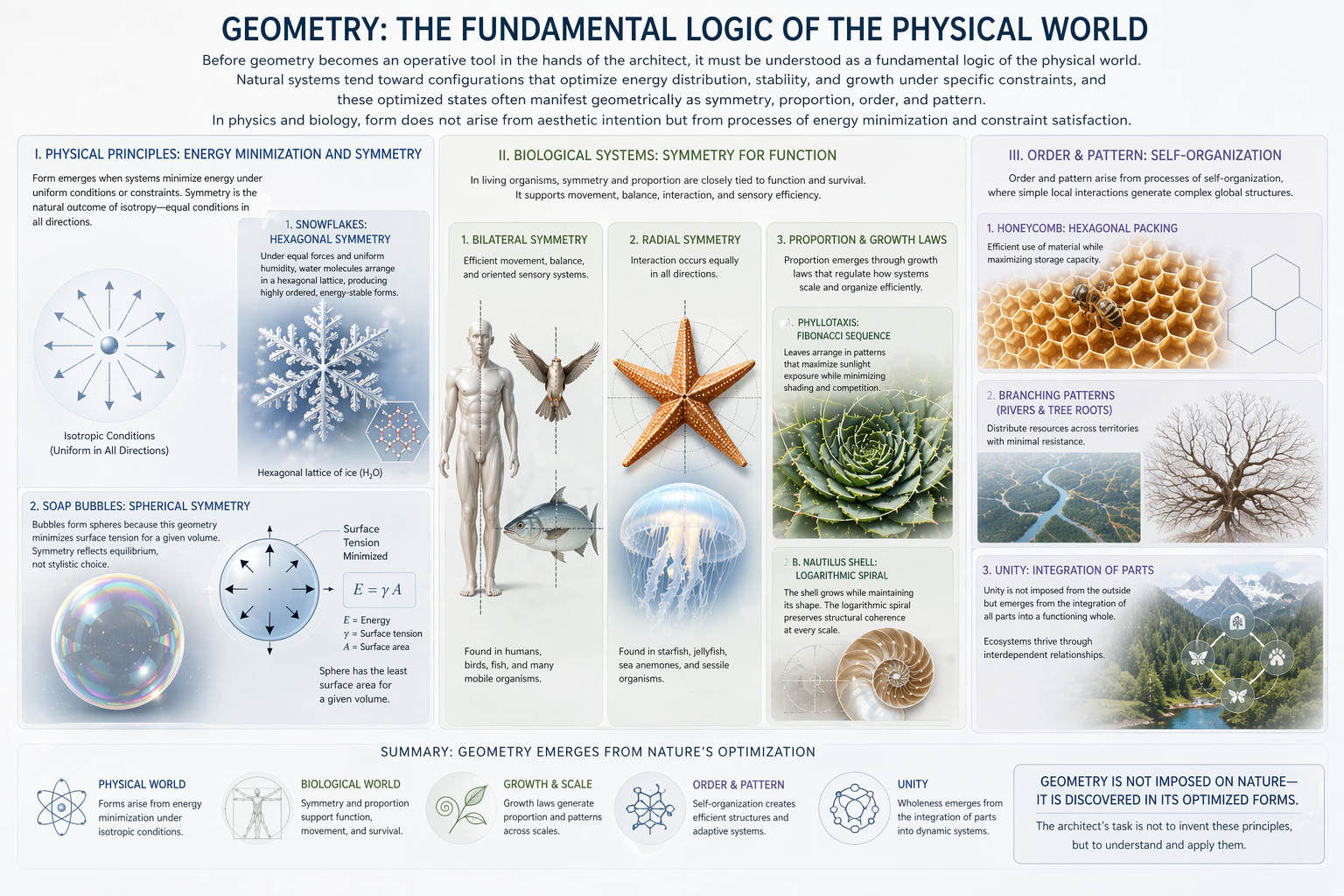
Before geometry becomes an operative tool in the hands of the architect, it must be understood as a fundamental logic of the physical world. Natural systems tend toward configurations that optimize energy distribution, stability, and growth under specific constraints, and these optimized states often manifest geometrically as symmetry, proportion, order, and pattern. In physics and biology, form does not arise from aesthetic intention but from processes of energy minimization and constraint satisfaction. Symmetry, for instance, emerges when conditions are isotropic—uniform in all directions. A clear example is the hexagonal structure of snowflakes, in which water molecules crystallize under equal forces, producing a highly ordered, symmetric form. Similarly, soap bubbles form spheres because that geometry minimizes surface tension for a given volume, demonstrating how symmetry reflects equilibrium rather than stylistic choice.
In living organisms, symmetry and proportion are closely tied to function and survival. Bilateral symmetry in animals—such as humans, birds, or fish—supports efficient movement, balance, and coordinated sensory systems, while radial symmetry in organisms like starfish corresponds to environments where interaction occurs equally in all directions. Proportion, on the other hand, emerges through growth laws that regulate how systems scale. The arrangement of leaves around a stem often follows Fibonacci sequences, allowing each leaf optimal exposure to sunlight without shading others. Similarly, the logarithmic spiral of a nautilus shell enables growth without altering overall form, maintaining structural and spatial coherence as the organism expands.
Order and pattern arise from processes of self-organization, where simple local interactions generate complex global structures. Examples include the hexagonal packing of cells in a honeycomb, which efficiently uses material while maximizing storage capacity, and the branching patterns of river networks and tree roots, which distribute resources across territories with minimal resistance. These patterns are not rigid impositions but dynamic equilibria, capable of adapting to changing conditions while maintaining overall coherence. Unity, therefore, is not imposed from the outside but emerges from the integration of all parts into a functioning whole, as seen in ecosystems where diverse organisms operate within interdependent relationships.
Importantly, nature does not rely solely on perfect symmetry or strict order. Controlled asymmetry and variation often enhance resilience. The human body, for example, is only approximately symmetrical, allowing for functional specialization of organs, while trees grow asymmetrically in response to wind or sunlight, optimizing stability and exposure. This demonstrates that what appears as irregularity is often a higher-order adaptation rather than disorder. When translated into architecture, these principles suggest that geometry should function as a responsive system rather than a fixed abstraction. Traditional Iranian architecture offers clear examples: windcatchers (badgirs) are proportioned and oriented to channel prevailing winds for passive cooling; courtyard houses use geometric order and symmetry to regulate light, shade, and airflow; and intricate brick or tile patterns modulate heat and light while creating visual coherence. In such cases, geometry is not decorative but performative, aligning environmental forces, human needs, and spatial organization. The result is a form of unity that is both experiential and ecological, demonstrating that geometry, when properly understood, is a mediator between natural laws and built form.