6. Geometry and Pattern.
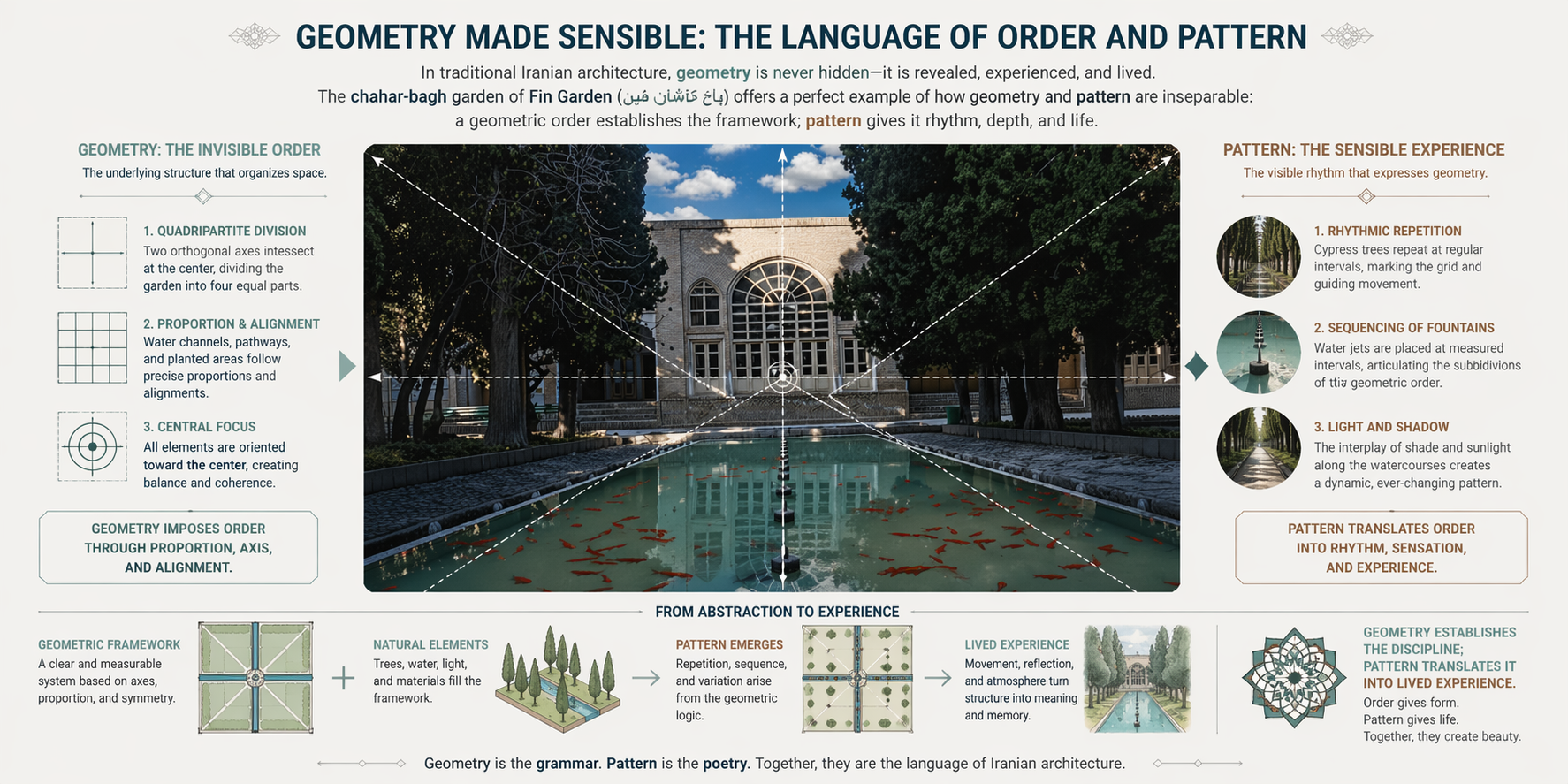
[The Fin Garden in Kashan (باغ فین کاشان)- geometry and pattern]
-
The distinction we outline between geometry and pattern becomes particularly lucid when viewed through the lens of traditional Iranian architecture, where the two are not only interdependent but often inseparable in practice. In these buildings, geometry rarely remains an abstract, hidden order; it is consistently brought to the surface, translated into patterns that can be seen, touched, and experienced.
Consider, for instance, the chahar-bagh garden typology exemplified by the باغ فین کاشان (Fin Garden in Kashan). At its geometric core lies a strict quadripartite division: two orthogonal axes intersecting at a central point, organizing water channels, pathways, and planted areas into a clear and measurable system. This is geometry in its most legible form—an imposition of order onto the landscape through proportion and alignment. Yet what one perceives while moving through the garden is not merely this abstract grid, but the rhythmic repetition of cypress trees, the sequencing of fountains, and the alternating play of light and shadow along the watercourses. The pattern emerges directly from the geometric framework: the spacing of trees follows the logic of the grid; the intervals of water jets articulate its subdivisions. Geometry establishes the discipline; pattern translates it into lived experience.
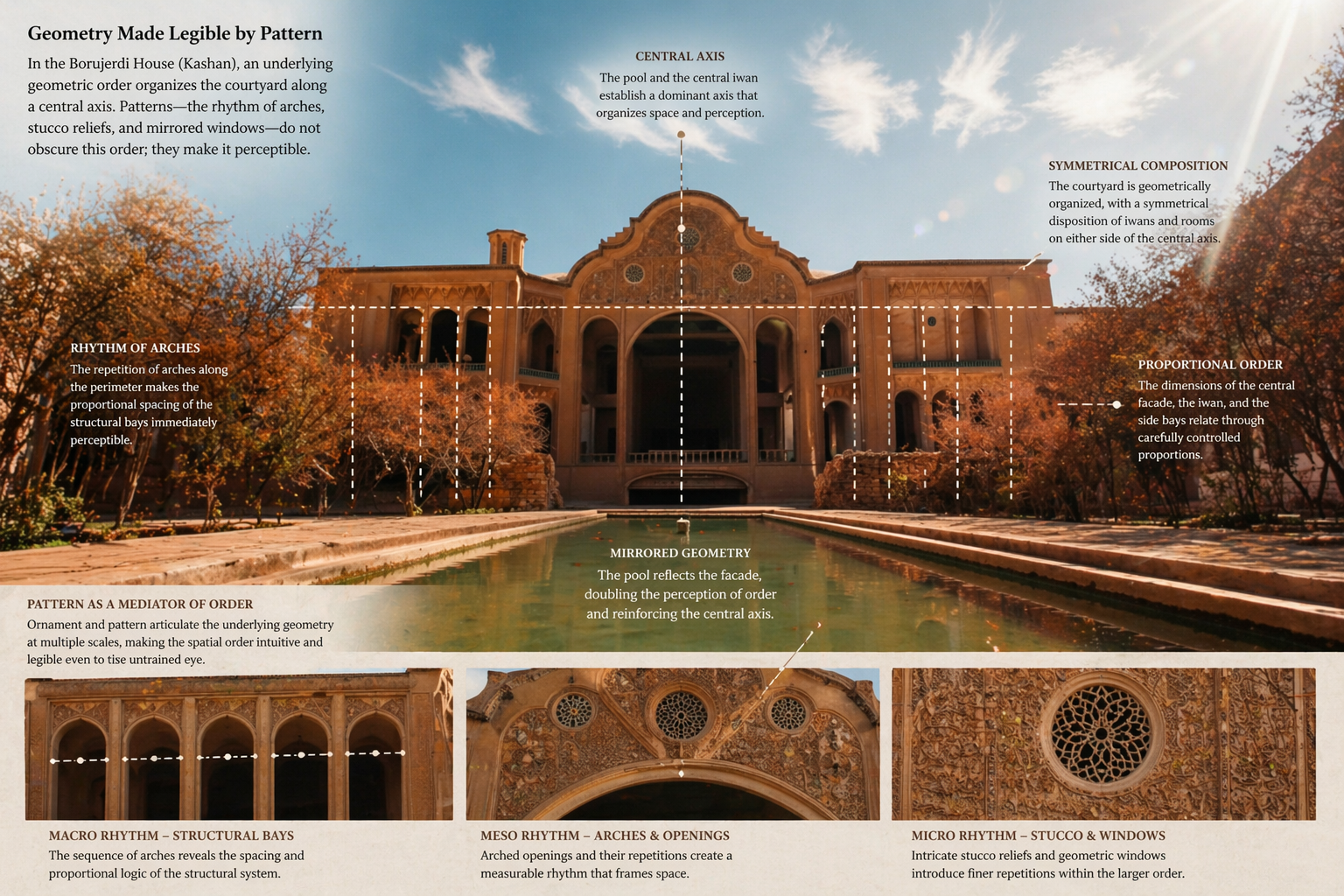
[The Borujerdi House in Kashan (خانه بروجردیها) geometry and pattern]
-
A similar relationship unfolds in the courtyards of traditional Iranian houses, such as those in Kashan or Yazd. The خانه بروجردیها (Borujerdi House) offers a compelling example. The courtyard is geometrically organized around a central axis, with carefully proportioned iwans and rooms arranged symmetrically. This underlying order governs circulation, orientation, and climatic performance. Yet what gives the space its perceptual richness is the patterned articulation of its surfaces: the repetition of arched openings, the intricate stucco reliefs, and the mirrored geometries of the windows. These patterns do not obscure the geometry; they render it legible. The rhythm of arches along the courtyard perimeter, for instance, makes the proportional spacing of the structural bays immediately perceptible, even to an untrained eye.
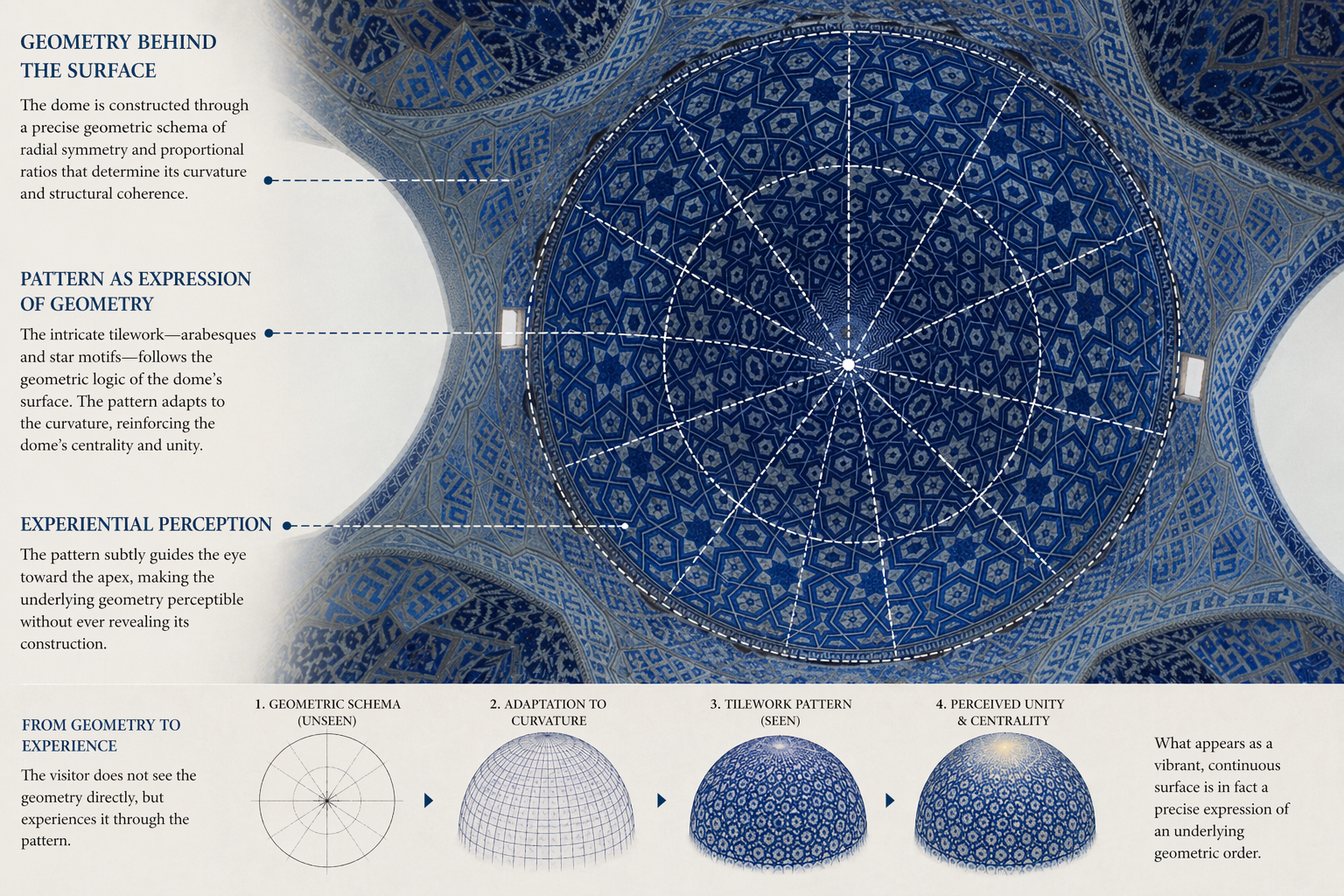
[Shah Mosque in Isfahan (مسجد شاه) geometry and pattern]
-
The mosques of Iran bring this interplay to an even higher level of refinement. In the Shah Mosque (مسجد شاه) in Isfahan, the dome is governed by a precise geometric schema—a system of radial symmetry and proportional ratios that determines its curvature and structural coherence. However, this geometry is almost impossible to perceive directly. What the visitor encounters instead is an intricate field of tilework: a dense, continuous pattern of arabesques and star motifs that seems to dissolve the dome's solidity into a luminous, vibrating surface. Yet this apparent dissolution is not a departure from geometry; it is its expression. The pattern follows the geometric logic of the dome’s surface, adapting to its curvature and reinforcing its centrality. As one looks upward, the pattern subtly guides the eye toward the apex, making the underlying geometry experientially present without ever explicitly revealing its construction.
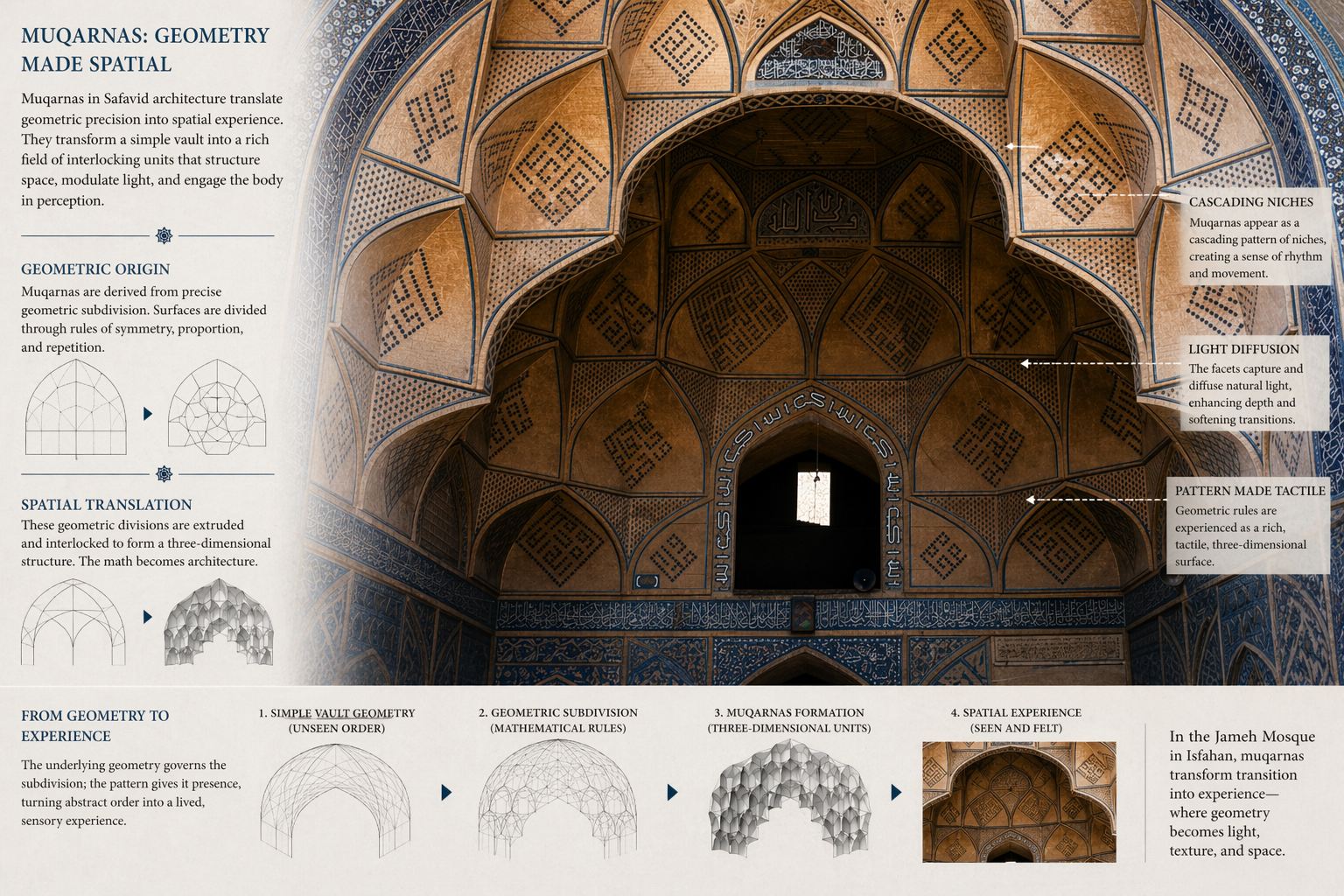
[The Masjed-e Jāmeh Isfahan (مسجد جامع اصفهان) geometry and pattern]
-
Perhaps the most striking examples of this synthesis are found in muqarnas, as seen in the entrances and iwans of many Safavid-era buildings. Muqarnas can be understood as a three-dimensional translation of geometric subdivision: a system that breaks down a surface or volume into smaller, interlocking units based on precise mathematical rules. Yet when encountered in space, muqarnas are perceived less as a geometric diagram and more as a cascading pattern of niches, a rhythmic fragmentation that captures and diffuses light. In the Jameh Mosque in Isfahan (مسجد جامع اصفهان), the muqarnas of the iwan vault transform a simple transitional geometry into a richly articulated spatial experience. The geometry dictates how the surfaces are subdivided; the pattern gives this subdivision a tactile and visual presence.
These examples demonstrate that in traditional Iranian architecture, geometry is rarely left in an abstract or concealed state. Instead, it is systematically externalized through a pattern. The grid becomes a rhythm of columns; the axis becomes a sequence of aligned openings; the curvature of a dome becomes a field of tessellated motifs. At the same time, a pattern never operates independently of geometry. Its repetitions, variations, and rhythms are always anchored in a deeper structural logic.
This reciprocal relationship produces an architecture that is both intellectually rigorous and sensorially rich. The observer may not consciously reconstruct the geometric system, but they feel its presence through pattern—through repetition, symmetry, and modulation. In this sense, pattern acts as a mediator between abstract order and human perception. It is the means by which geometry becomes experience, and through which the underlying structure of a building is made both visible and affective.