2. From Measurement to Meaning: The Evolution of Geometry as Architecture’s Primary Medium.
-
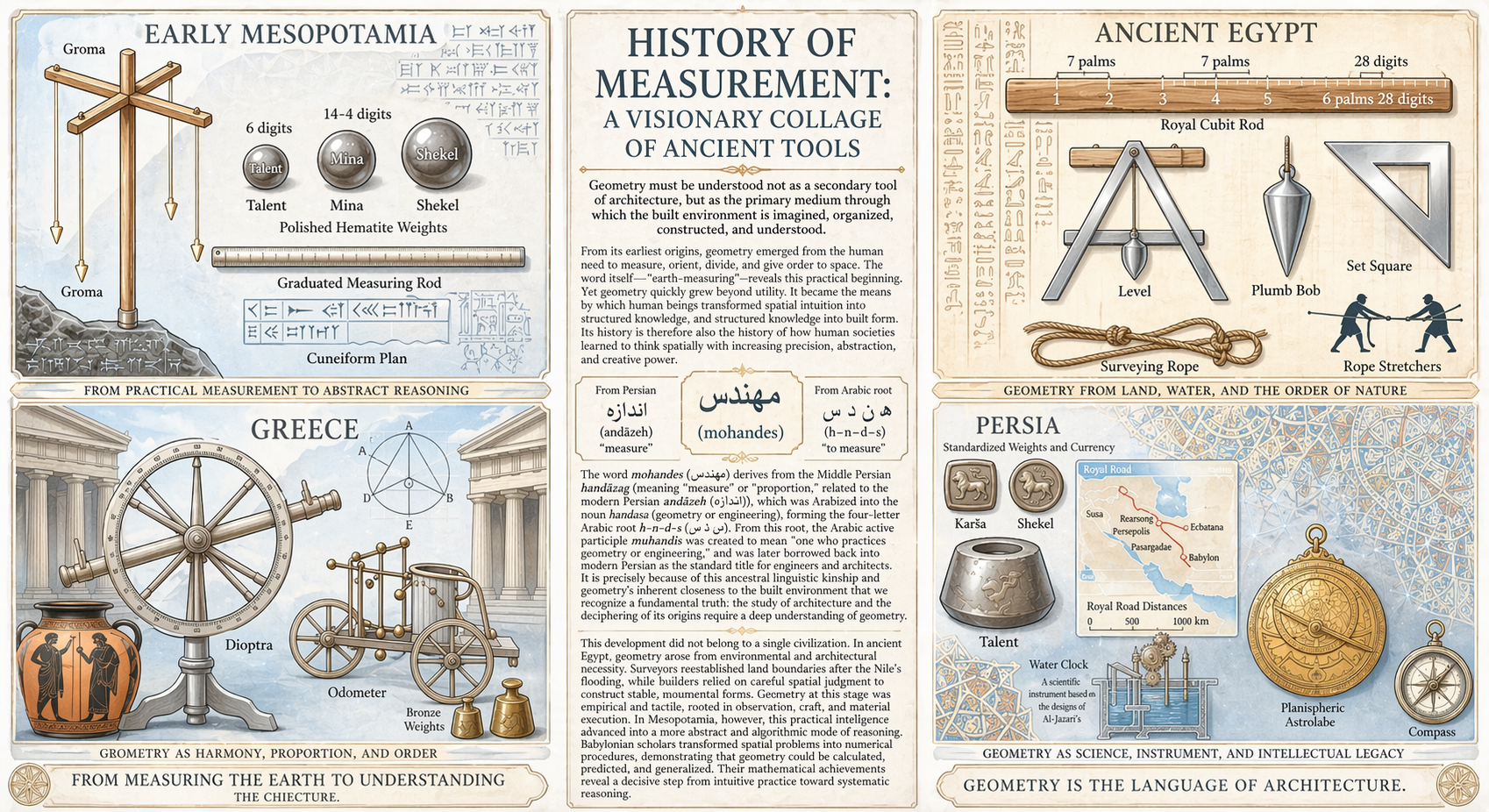
Geometry must be understood not as a secondary tool of architecture, but as the primary medium through which the built environment is imagined, organized, constructed, and understood. From its earliest origins, geometry emerged from the human need to measure, orient, divide, and give order to space. The word itself— “earth-measuring”—reveals this practical beginning. Yet geometry quickly grew beyond utility. It became the means by which human beings transformed spatial intuition into structured knowledge, and structured knowledge into built form. Its history is therefore also the history of how human societies learned to think spatially with increasing precision, abstraction, and creative power.
The word mohandes (مهندس) derives from the Middle Persian handāzag (meaning "measure" or "proportion," related to the modern Persian andāzeh (اندازه)), which was Arabized into the noun handasa (geometry or engineering), forming the four-letter Arabic root h-n-d-s (ه ن د س). From this root, the Arabic active participle muhandis was created to mean "one who practices geometry or engineering," and was later borrowed back into modern Persian as the standard title for engineers and architects. It is precisely because of this ancestral linguistic kinship and geometry's inherent closeness to the built environment that we recognize a fundamental truth: the study of architecture and the deciphering of its origins require a deep understanding of geometry.
This development did not belong to a single civilization. In ancient Egypt, geometry arose from environmental and architectural necessity. Surveyors reestablished land boundaries after the Nile's flooding, while builders relied on careful spatial judgment to construct stable, monumental forms. Geometry at this stage was empirical and tactile, rooted in observation, craft, and material execution. In Mesopotamia, however, this practical intelligence advanced into a more abstract and algorithmic mode of reasoning. Babylonian scholars transformed spatial problems into numerical procedures, demonstrating that geometry could be calculated, predicted, and generalized. Their mathematical achievements reveal a decisive step from intuitive practice toward systematic reasoning.
-
The Greeks inherited and transformed these earlier traditions. Thinkers such as Thales and Pythagoras drew upon Near Eastern knowledge, but Greek mathematics shifted the emphasis from computation to proof. With Euclid’s Elements, geometry became an axiomatic system grounded in deduction, definitions, and universal demonstration. Yet the history of geometry does not end there. Iranian polymaths of the Golden Age carried this intellectual lineage forward in decisive ways. Al-Khwarizmi established algebra as a rigorous discipline and helped reconnect numerical reasoning with geometric demonstration. Omar Khayyam extended this synthesis through geometric solutions to cubic equations, while Al-Farabi and Avicenna deepened the philosophical and practical understanding of mathematics as a foundation for the arts and sciences. Through their work, geometry became not only a science of space but a bridge between abstract thought and material reality.
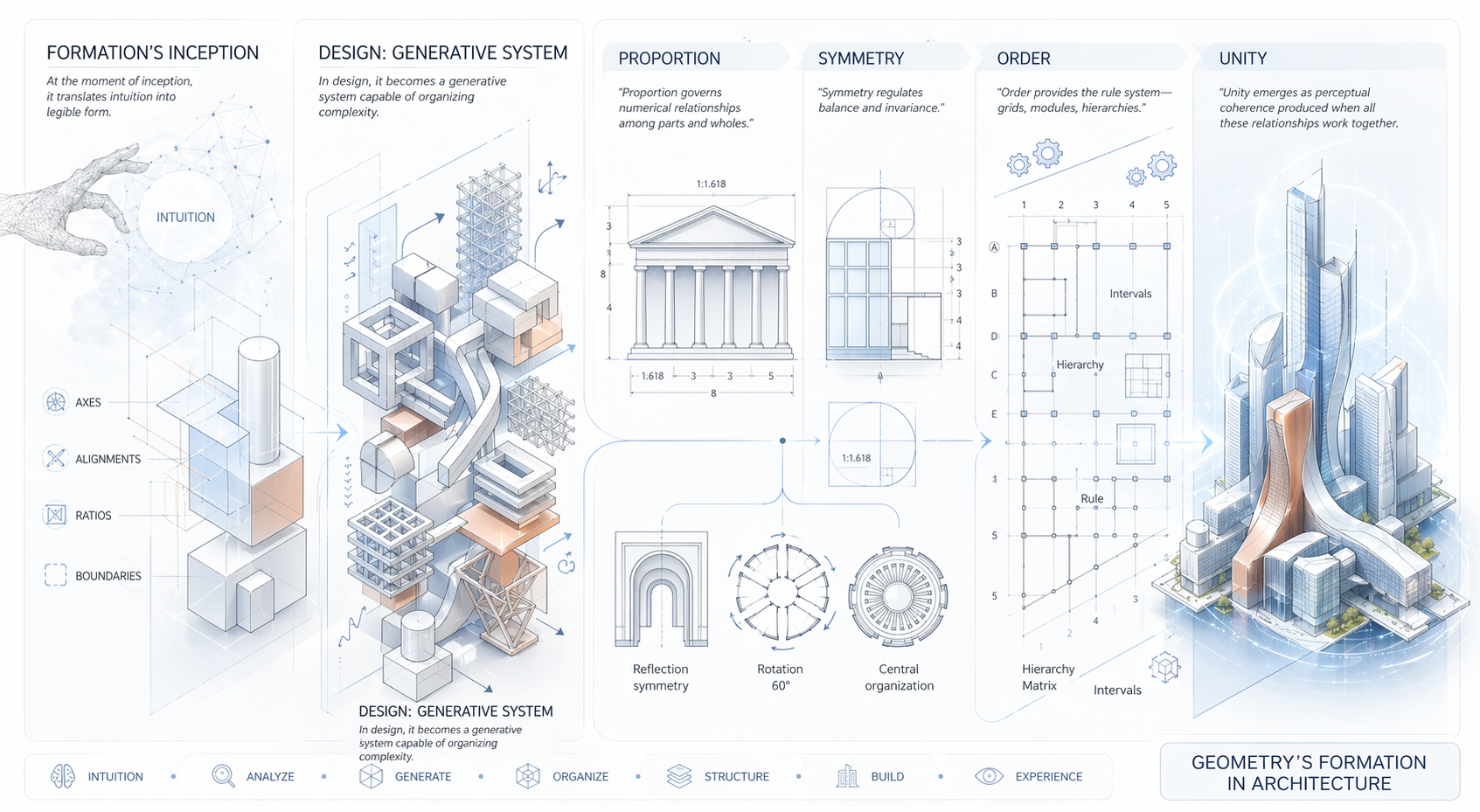
Within architecture, geometry operates at every stage of formation. At the moment of inception, it translates intuition into legible form through axes, boundaries, ratios, and alignments. In design, it becomes a generative system capable of organizing complexity without collapsing into arbitrariness. Through geometry, architecture establishes proportion, symmetry, order, and ultimately unity. Proportion governs numerical relationships among parts and wholes. Symmetry regulates balance and invariance through reflection, rotation, or central organization. Order provides the rule system—grids, modules, hierarchies, intervals—through which elements are arranged. Unity emerges as the perceptual coherence produced when all these relationships work together.
[Figure 3- proportion, symmetry, order, and ultimately unity]
Pattern arises from this same geometric field. It is not separate from geometry, but the visible and experiential extension of geometric logic through repetition and transformation. When proportional relationships recur across bays, surfaces, structures, or urban fabrics, they become perceptible as rhythm. When symmetry governs repetition, pattern acquires stability and legibility. When order regulates intervals and hierarchy, the pattern becomes intelligible rather than random. Unity is then perceived as the coherent whole produced by these patterned relationships. Geometry thus generates the relational framework; pattern makes it visible; proportion calibrates it; symmetry stabilizes it; order structures it; and unity completes it as an architectural experience.
For this reason, geometry is inseparable from both architecture and urban design. It guides conception, directs production, and conditions perception. It links imagination to realization and form to understanding. Whether in ancient monuments, intricate vaulting systems, modular construction, or contemporary computational design, geometry remains the deep language of the built environment: not simply an instrument applied to form, but the very logic through which form comes into being and becomes meaningful.