5. Embedded Geometry: Architecture Between Abstraction and Lived Reality.
-
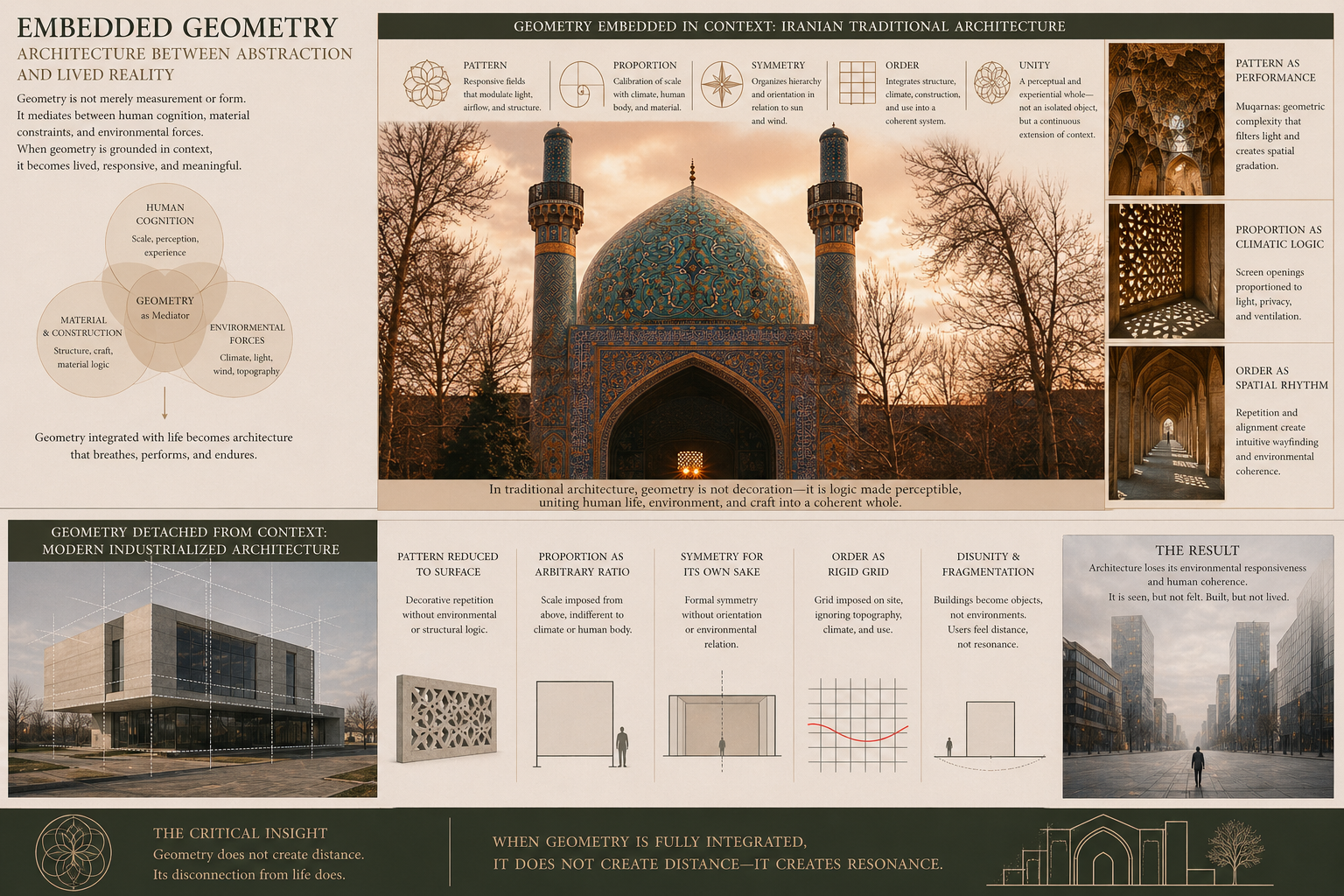
When we return to the built environment, this biological and natural foundation clarifies why architecture cannot be a purely abstract exercise. Geometry historically evolved from embodied spatial intuition into increasingly formalized systems—Mesopotamian algorithms, Greek axioms, and later algebraic-geometric syntheses. This progression did not inherently distance architecture from human or environmental realities; in fact, at its peak—particularly in Iranian intellectual and architectural traditions—it produced a synthesis where abstraction and lived experience remained tightly coupled. The problem arises in later conditions, especially in modern and industrialized contexts, where geometry becomes detached from context and reduced to a purely instrumental or formal exercise.
Within the framework of geometry, pattern, proportion, symmetry, order, and unity, this distinction becomes clearer. Geometry, in its most complete architectural role, is not merely a system of measurement but a mediator between human cognition, material constraints, and environmental forces. When geometry is grounded in context, pattern emerges not as decorative repetition but as a responsive field—modulating light, airflow, structure, and movement. In Iranian traditional architecture, patterns such as those in muqarnas, brickwork, or screen systems are not arbitrary formalizations; they are geometrically rigorous yet environmentally performative, filtering light, regulating heat, and structuring spatial gradients.
Proportion, in this context, is not an abstract ratio imposed from above but a calibration between human scale, climatic conditions, and material logic. The dimensions of courtyards, the height of iwans, or the thickness of walls are proportioned in relation to solar angles, thermal mass, and patterns of inhabitation. Symmetry, similarly, is not merely a compositional device for visual balance; it organizes spatial hierarchy and orientation, often aligned with environmental axes such as prevailing winds or solar paths. Order, then, is not an imposed grid detached from reality but a rule system that integrates construction, climate, and use into a coherent framework. Unity emerges as the perceptual and experiential consequence of this integration, where the building is not perceived as an isolated object but as a continuous extension of its environmental and cultural context.
What distinguishes much of Iranian traditional architecture is precisely this refusal to separate geometric abstraction from lived reality. Geometry remains operative at all levels—conceptual, formal, environmental, and experiential—so that pattern is both visual and performative, proportion is both numerical and climatic, symmetry is both spatial and orientational, and order is both structural and ecological. The result is a form of unity that is not merely aesthetic but systemic: a coherence between human needs, environmental forces, and spatial organization.
In contrast, when geometry becomes detached—when pattern is reduced to surface decoration, proportion to arbitrary ratios, symmetry to formal symmetry for its own sake, and order to rigid grids indifferent to context—the architectural process fragments. The user can no longer intuitively read or inhabit the space's logic, and the building loses its environmental responsiveness. The perceived “distance” you describe is therefore not caused by geometry itself, but by a rupture in how geometric logic is deployed.
The critical insight, therefore, is this: the most successful architectural traditions do not reject abstraction; rather, they embed it within environmental and human realities. Geometry, when fully integrated, does not create distance—it creates resonance.